Human CD4+ T cell enrichment is often used to create a defined T-cell population for downstream immune-cell workflows. Magnetic positive selection offers a direct way to capture the marker-positive population, but the separation reagent still needs to fit the next experimental step—not just the enrichment step itself. MileCell MagSep™ CD4 MicroBeads, Human (Cat. No. AB0001) […]
CD8+ T cell isolation from PBMCs is often treated as a simple enrichment step, but the best isolation strategy depends on what comes next. A workflow designed for maximum marker-defined enrichment may not be the same workflow chosen when an unlabeled target fraction is preferred. Purity matters, but so do cell handling, compatibility with downstream […]
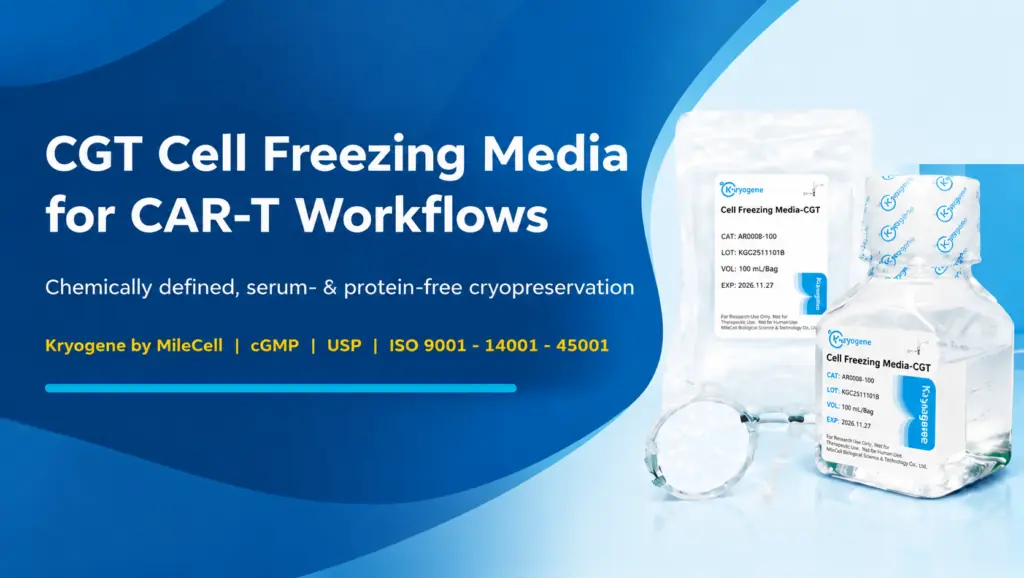
Cryopreservation sits at a critical point in a CAR-T workflow because the cells must remain usable after freezing, storage, and thawing. A useful freezing medium therefore has to support more than a single immediate post-thaw reading: teams need evidence that cell viability, viable recovery, and engineered-cell characteristics remain measurable through recovery. Kryogene Cell Freezing Media […]
A freezing workflow is only useful if the cells remain suitable for the experiments that follow thawing. In cell therapy research, that can mean evaluating more than post-thaw viability alone: mesenchymal stem cell (MSC) studies may also examine cell-surface markers and differentiation, while T-cell workflows may require activation and proliferation readouts after recovery. Kryogene Cell […]
Rat peripheral blood mononuclear cells (PBMCs) are a practical primary-cell model for preclinical programs that need to connect circulating immune biology with in vivo rat studies. Because PBMCs contain mononuclear leukocyte populations from peripheral blood, they can support immune profiling, ex vivo functional studies, and translational comparisons without requiring a solid lymphoid tissue source. For […]
Mouse peripheral blood mononuclear cells (PBMCs) are a practical starting material for immune profiling when a study needs to remain aligned with a defined mouse model. Because PBMCs represent circulating mononuclear immune populations, they can support phenotyping and ex vivo assay workflows without requiring isolation from a solid lymphoid organ. For study planning, the important […]
Drug-induced liver injury (DILI) and hepatic transporter studies often demand more from an in vitro liver model than short-term metabolic turnover. The cells need to attach reliably, maintain hepatocyte morphology, and – for many transporter workflows – recover the polarity and bile canaliculi architecture that are central to hepatobiliary handling.Plateable primary hepatocytesare designed for this […]
Sandwich-cultured hepatocytesare most useful when the study question depends on polarized hepatocyte function rather than attachment alone. Plateable hepatocytes can be used in monolayer, sandwich-culture, and spheroid formats, but the sandwich configuration is specifically designed to support re-establishment of cellular polarity and formation of bile canaliculi-like networks. That distinction matters for transporter and hepatobiliary studies. […]
Positive vs negative selection for immune cells is a practical decision that shapes the rest of an immune-cell workflow. Both approaches use magnetic separation, but they differ in what is selected and how the desired population is obtained. In the MileCell MagSep™ portfolio, positive selection uses marker-specific MicroBeads to enrich a defined target population, while […]
Cell isolationsits upstream of many immunology and immuno-oncology workflows. When a mixed sample contains several immune-cell populations, the separation step determines which cells move forward into flow cytometry, in vitro culture, or single-cell sequencing. The challenge is not simply to capture cells; it is to enrich or deplete the right population while keeping the workflow […]
Login
Sign Up
Welcome back. Please sign in to access your MileCell account.
We use cookies to improve your browsing experience, analyze traffic, and support personalized advertising. You can accept, reject, or customize optional cookies. Privacy Policy
Essential cookies
Always active
Ensure the basic functions of the website (such as login and shopping cart), which cannot be disabled as doing so will render the website unusable.
Preference setting cookie
Remember your personalized choices (such as language, theme), and you will need to manually set them each time after closing.
Statistical analysis of cookies
The technical storage or access that is used exclusively for statistical purposes.Collect anonymous access data for website optimization, which does not involve personal identity information, and its closure does not affect core functions.
Marketing advertising cookie
Used for precise advertisement delivery and tracking browsing behavior. After being disabled, personalized advertisement recommendations will no longer be provided.