
A freezing workflow is only useful if the cells remain suitable for the experiments that follow thawing. In cell therapy research, that can mean evaluating more than post-thaw viability alone: mesenchymal stem cell (MSC) studies may also examine cell-surface markers and differentiation, while T-cell workflows may require activation and proliferation readouts after recovery.
Kryogene Cell Freezing Media – DMSO Free is designed for research-use cell freezing workflows where DMSO-free preservation is preferred. The formulation contains no DMSO, serum, or animal-derived components and is positioned for routine cell storage, in vitro model development, and other cell-based research applications. Its performance data include umbilical cord-derived MSCs (UC-MSCs), adipose tissue-derived MSCs (AD-MSCs), and human CD4+ and CD8+ T cells.
This article focuses on the practical question behind the keyword: what should researchers look for in DMSO-free freezing media when the goal is to preserve cells for downstream cell therapy research assays?
DMSO-free freezing media are cryopreservation solutions used when a workflow is intended to avoid dimethyl sulfoxide during freezing. For Kryogene Cell Freezing Media – DMSO Free, the formulation is also serum-free and free of animal-derived components. The product is described for research-use cryopreservation, with an optimized formulation intended to support cell viability and post-thaw recovery.
That positioning is important. This DMSO-free product is not presented as the same product as Kryogene Cell Freezing Media – CGT. The DMSO-free formulation is described as research-use quality, so clinical-grade or cGMP claims associated with the separate CGT product should not be transferred to AR0020-100.
| Research-use positioning: Kryogene Cell Freezing Media – DMSO Free (Cat. No. AR0020-100) is presented for research-use cryopreservation workflows. The product information does not state a clinical-grade or cGMP claim for this DMSO-free formulation. |
The performance studies for the DMSO-free medium were designed around downstream biological readouts rather than a single endpoint. For MSCs, the dataset includes viability, surface-marker expression, and osteogenic, chondrogenic, and adipogenic differentiation. For T cells, the studies include post-thaw CD25/CD69 activation-marker measurements and proliferation after stimulation.
This creates a practical evaluation framework for research teams: assess whether the freezing medium supports the specific readouts that matter for the cell type being studied. A viability result is useful, but a broader post-thaw panel can show whether cells remain usable for phenotype and functional assays.
The MSC performance test compares Kryogene Cell Freezing Media – DMSO Free with Competitor 2 after cryopreservation. Post-thaw viability was measured for both UC-MSCs and AD-MSCs. In the plotted data, the DMSO-free group maintains high viability in both cell types and falls within the same overall performance range as the comparator.
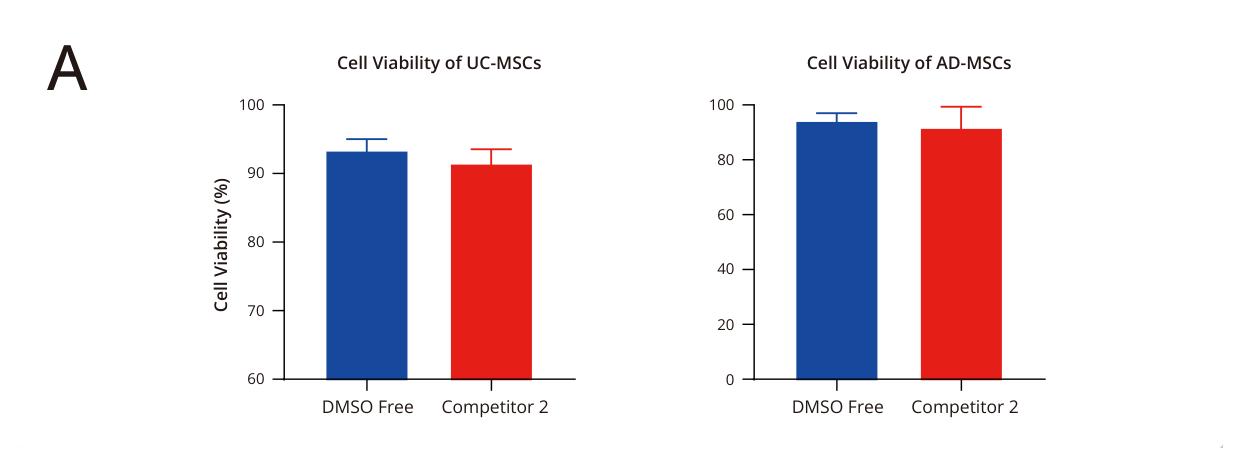

Figure 1. Post-thaw cell viability of UC-MSCs and AD-MSCs cryopreserved with Kryogene Cell Freezing Media – DMSO Free versus Competitor 2. Data image reproduced from the product performance dataset and placed on a white background for publication.
Post-thaw characterization also included cell-surface marker measurements. UC-MSCs were evaluated for CD90, CD73, CD105, and CD45. AD-MSCs were evaluated for CD90, CD73, CD105, CD45, and CD34. The plotted DMSO-free and Competitor 2 groups show closely aligned marker profiles across the measured panels.
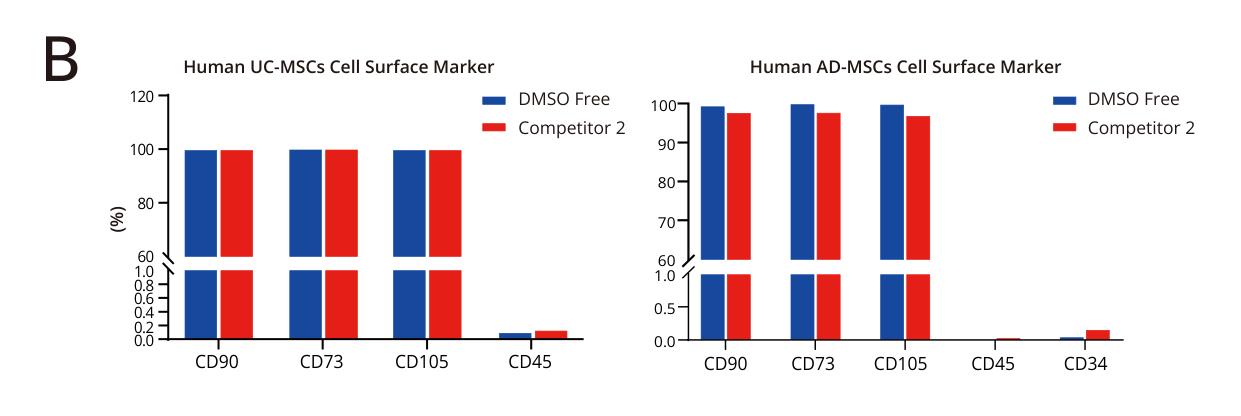

Figure 2. Post-thaw surface-marker expression of UC-MSCs and AD-MSCs after cryopreservation with Kryogene Cell Freezing Media – DMSO Free and Competitor 2.
The same MSC study extended beyond viability and marker expression. After thawing, UC-MSCs and AD-MSCs were assessed for osteogenic, chondrogenic, and adipogenic differentiation. The image panels document all three differentiation readouts for the DMSO-free group and Competitor 2, providing a functional layer to the post-thaw evaluation.
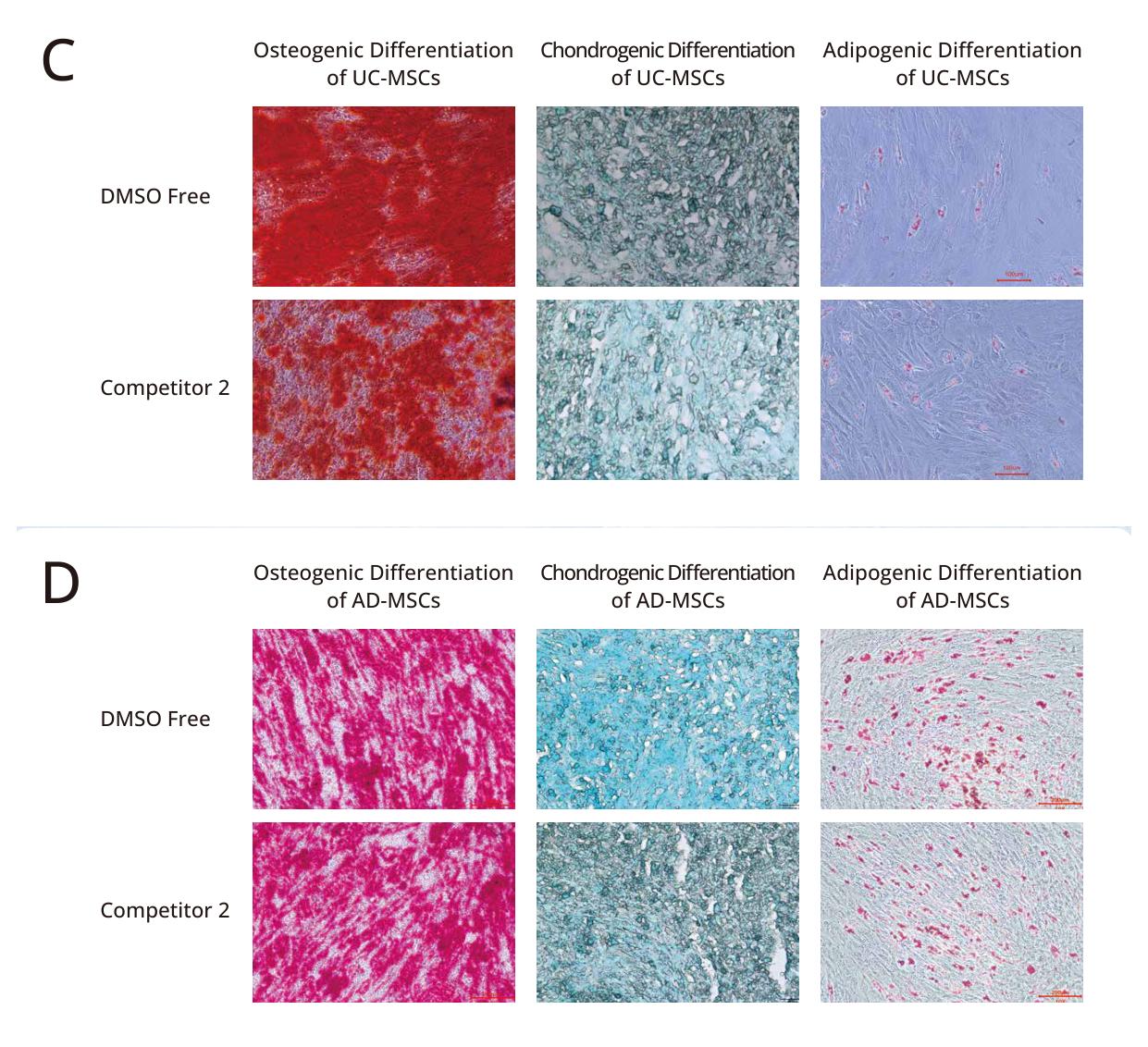

Figure 3. Post-thaw osteogenic, chondrogenic, and adipogenic differentiation assessments of UC-MSCs and AD-MSCs cryopreserved with Kryogene Cell Freezing Media – DMSO Free and Competitor 2.
Human CD4+ and CD8+ T cells were cryopreserved with the DMSO-free medium and a DMSO-containing competitive product. After thawing, cells were stimulated for 20 hours with an activation cocktail containing PMA and ionomycin, followed by flow-cytometry detection of CD25 and CD69. The study reports CD4/CD25/CD69 measurements for the CD4+ T-cell group and CD8/CD25/CD69 measurements for the CD8+ T-cell group under stimulated and unstimulated conditions.
For researchers working with post-thaw immune-cell assays, this type of dataset is useful because it tests whether cells can still be taken forward into an activation experiment after cryopreservation rather than stopping at a survival readout.
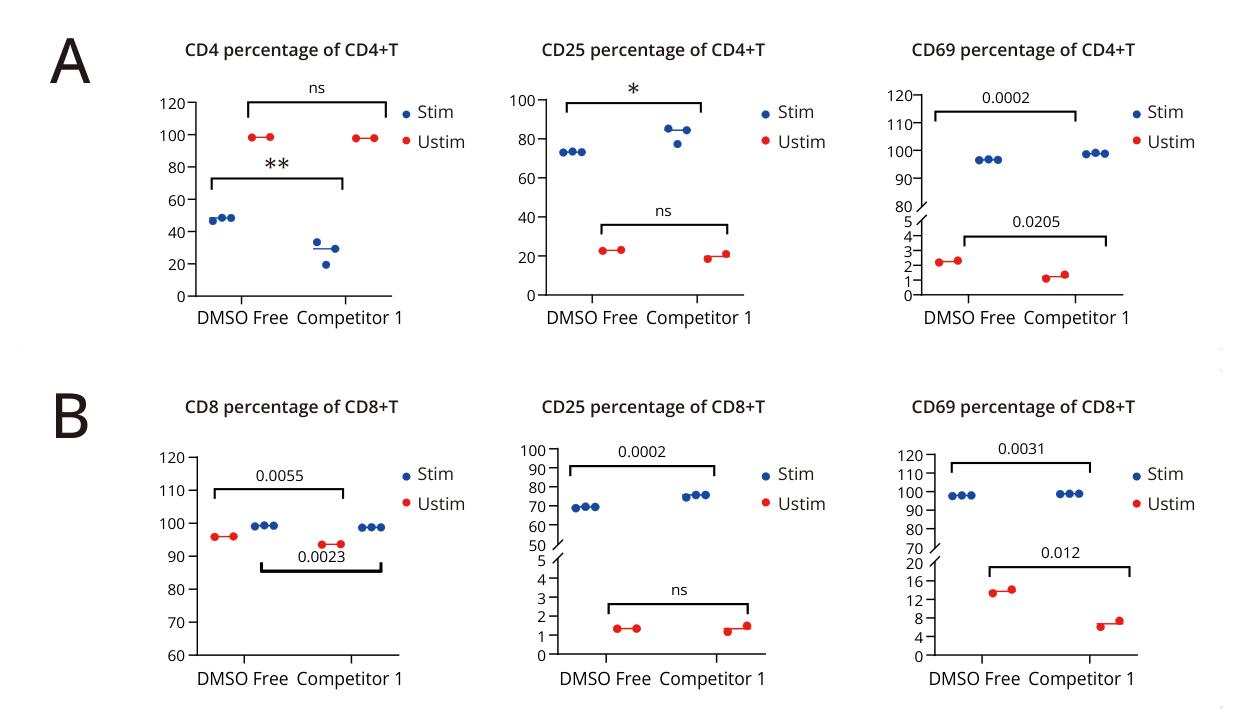

Figure 4. Post-thaw activation-marker analysis of human CD4+ and CD8+ T cells cryopreserved with Kryogene Cell Freezing Media – DMSO Free and a DMSO-containing competitor. Cells were stimulated for 20 hours with PMA + ionomycin before flow-cytometry analysis of CD25/CD69.
A second T-cell experiment examined proliferation after thawing. Human CD4+ and CD8+ T cells were stimulated with coated anti-CD3/CD28 antibodies and cultured for 3 days before flow-cytometry detection of proliferation. The plotted expansion-fold readout relative to the unstimulated group was 3.1 for CD4+ T cells in the DMSO-free group versus 3.7 for Competitor 1. For CD8+ T cells, the values were 2.12 for the DMSO-free group and 1.79 for Competitor 1.
These results add a functional proliferation endpoint to the DMSO-free cryopreservation dataset and complement the activation-marker measurements shown above.
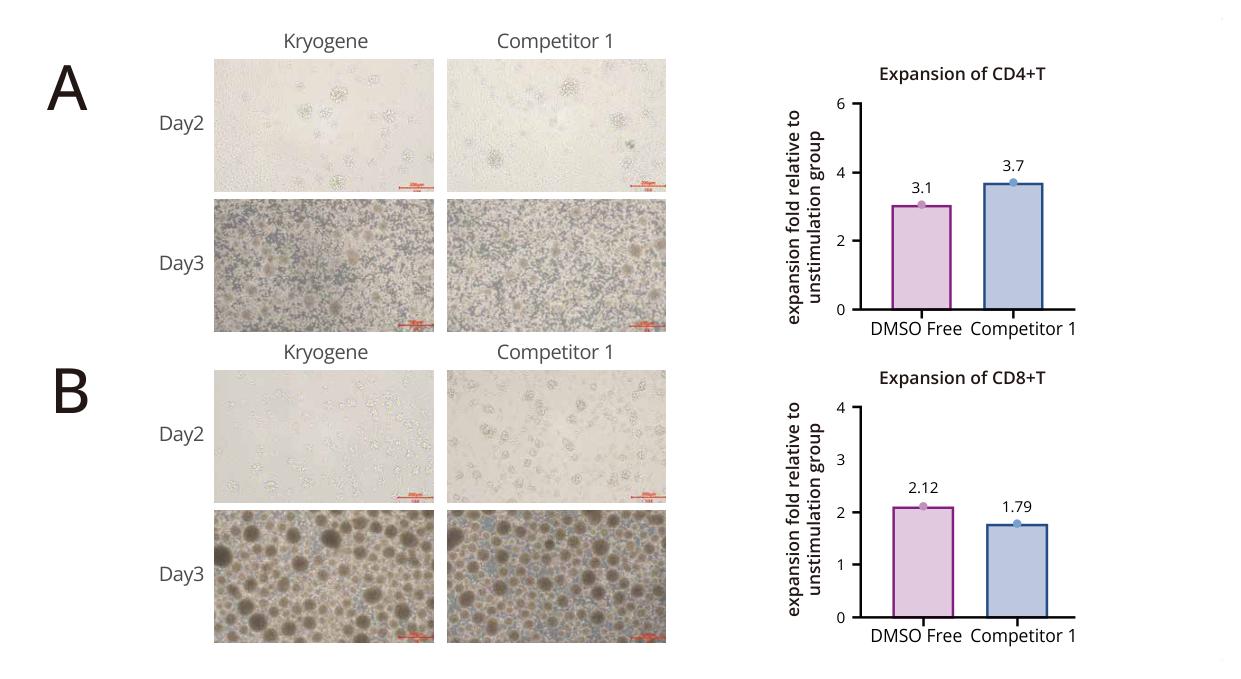

Figure 5. Post-thaw CD4+ and CD8+ T-cell proliferation after coated anti-CD3/CD28 stimulation and 3 days of culture. Expansion-fold values are shown relative to the unstimulated group.
For a research workflow, the most useful selection criteria are the ones that connect formulation, post-thaw biology, and product quality. The performance and product information for the DMSO-free formulation support the following checklist.
| Evaluation Area | What to Check |
| Formulation | Is the medium free of DMSO, serum, and animal-derived components? |
| Post-thaw viability | Has viability been assessed in relevant cell types such as UC-MSCs and AD-MSCs? |
| Phenotype | Are post-thaw cell-surface markers included in the evaluation? |
| Functional readouts | Are differentiation, activation, or proliferation assays shown for the intended cell type? |
| Manufacturing control | Is the product manufactured using a controlled process intended to reduce batch-to-batch variability? |
| Quality testing | Are appearance, pH, osmolality, sterility, and endotoxin included among batch quality tests? |
| Research-use fit | Does the product positioning match a research-use cryopreservation workflow? |
Kryogene Cell Freezing Media – DMSO Free is a universal research-use cryopreservation medium intended for workflows where DMSO-free preservation is preferred. The formulation is designed to support cell viability and post-thaw recovery while removing DMSO from the freezing process.
· DMSO-, serum-, and animal-derived component-free formulation for cell-based research applications.
· Research-use quality control under a controlled quality management process.
· Controlled manufacturing process designed to help reduce batch-to-batch variability and support consistent product quality.
· Each batch is tested for key parameters including appearance, pH, osmolality, sterility, and endotoxin level.
· Performance data include UC-MSCs, AD-MSCs, and human CD4+ and CD8+ T cells in post-thaw assays.
| Cat. No. | Product Description | Size | Store at |
| AR0020-100 | Cell Freezing Media – DMSO Free | 100 mL/Bottle | 2-8 °C |
| Quality management systemsMileCell/Kryogene product materials display ISO 9001, ISO 14001, and ISO 45001 management-system certifications. These should be described as company/system-level quality credentials rather than as a clinical-grade claim for the DMSO-free product. |
The DMSO-free formulation is positioned for routine cell storage, in vitro model development, and cell-based research applications. The available performance studies specifically demonstrate its use in MSC and T-cell cryopreservation experiments, making it relevant to research teams that want to evaluate post-thaw viability together with phenotype or functional readouts.
For projects that require a different regulatory or manufacturing profile, product selection should be based on the claims of the specific Kryogene formulation being considered. The DMSO-free product and the separate Cell Freezing Media – CGT product have different positioning and should be evaluated independently.
No. The formulation is designed to eliminate dimethyl sulfoxide from the freezing process.
Yes. The product is formulated without DMSO, serum, or animal-derived components.
The dataset includes UC-MSCs, AD-MSCs, human CD4+ T cells, and human CD8+ T cells.
For MSCs, the dataset includes viability, surface-marker expression, and osteogenic, chondrogenic, and adipogenic differentiation. For T cells, it includes activation-marker analysis after PMA + ionomycin stimulation and proliferation after coated anti-CD3/CD28 stimulation.
Kryogene Cell Freezing Media – DMSO Free is supplied as 100 mL per bottle under Cat. No. AR0020-100 and is stored at 2-8 °C.
The DMSO-free product is described as research-use quality for research-use cryopreservation workflows. Clinical-grade and cGMP claims are not stated for AR0020-100 in the product information used for this article.
DMSO-free freezing media for cell therapy research should be evaluated against the post-thaw endpoints that matter for the intended experiment. In the Kryogene dataset, Cell Freezing Media – DMSO Free was assessed not only for MSC viability, but also for MSC surface markers and differentiation, as well as T-cell activation and proliferation after thawing.
The formulation is free of DMSO, serum, and animal-derived components, is manufactured using a controlled process, and is supported by batch testing for appearance, pH, osmolality, sterility, and endotoxin. For research teams building DMSO-free cryopreservation workflows around MSC or T-cell assays, these data provide a practical basis for product evaluation.
| Explore Kryogene Cell Freezing Media – DMSO Free: Need a DMSO-free option for an MSC or T-cell research workflow? Contact the MileCell team for product information and application support. Info@milecell-bio.com | www.milecell-bio.com |