
Key takeaway: PBMC subpopulation profiling by flow cytometry turns a mixed-cell sample into a usable immune map. In the provided rhesus monkey PBMC example, the sample contains CD45+ leukocytes (98.35%), CD3+ T cells (66.09%), CD20+ B cells (25.83%), and CD14+ monocytes (4.03%).
PBMC subpopulation profiling by flow cytometry helps researchers move beyond the label “PBMCs” and understand what is actually present in a sample. For immune phenotyping, functional assays, and translational studies, that matters because the performance of a mixed-cell sample depends on the balance of its immune-cell populations—not simply on the fact that PBMCs are available.
MileCell’s animal immune-cell portfolio is designed for immunology-focused research and highlights high post-thaw viability, rigorous QC, reliable lot consistency, broad species coverage, and customizable supply options. When those features are paired with subpopulation profiling data, researchers gain a clearer view of whether a PBMC preparation is fit for flow-cytometry-based studies and downstream immune assays.
Peripheral blood mononuclear cells (PBMCs) are the mononuclear immune-cell fraction isolated from peripheral blood. Flow cytometry is commonly used to identify and quantify the immune-cell populations within that fraction by measuring marker-defined subsets such as leukocytes, T cells, B cells, and monocytes.
For practical assay planning, PBMC subpopulation profiling serves two purposes. First, it verifies that the cell sample contains the populations required for the intended study. Second, it gives researchers a more interpretable starting point for comparing assay readouts across runs, lots, or species.
A PBMC sample is a mixed population. If a workflow depends on T-cell, B-cell, or monocyte behavior, flow-cytometry profiling helps confirm that those populations are present at measurable levels before the study begins.
Flow data can guide marker selection, control strategy, and expected signal interpretation. This is especially useful when the endpoint depends on a subset that may represent only a portion of the full PBMC population.
MileCell emphasizes rigorous QC and reliable lot consistency across its animal immune-cell portfolio. Composition data add another layer of confidence by showing how the sample is distributed across key immune subsets.
Some studies benefit from a mixed PBMC context, while others are better served by a defined immune subset. MileCell also offers custom cell-isolation services for subtypes such as CD3/CD4/CD8, CD14, CD19, and CD56, which can be useful when the assay needs a more focused starting population.
The product materials include a representative flow-cytometry characterization of rhesus monkey PBMCs. The example provides a useful snapshot of how a mixed PBMC sample can be interpreted before downstream use.
The example shows an R1 gate of 75.00%, a Cells gate of 98.59%, and a P1 population of 55.16%. These values describe the sample shown in the characterization figure and provide context for the downstream subset analysis.
Within the characterized sample, CD45+ leukocytes account for 98.35%, CD3+ pan T cells for 66.09%, CD20+ B cells for 25.83%, and CD14+ monocytes for 4.03%. Together, these values indicate a leukocyte-rich preparation with clearly detectable lymphoid and myeloid components.
The CD3+ gate is further resolved into CD4+CD8− cells (64.97%), CD4−CD8+ cells (30.00%), CD4+CD8+ cells (2.89%), and CD4−CD8− cells (2.14%). This breakdown helps researchers understand how the T-cell compartment is distributed within the profiled PBMC sample.
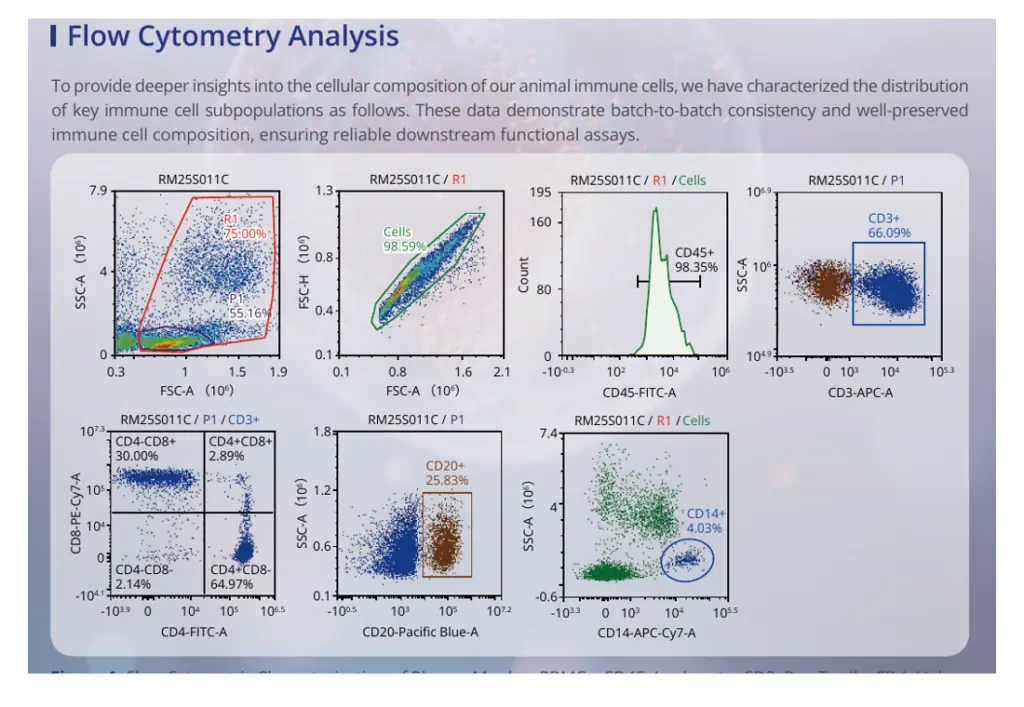
Figure 1. Flow-cytometric characterization of rhesus monkey PBMCs. Marker definitions: CD45, leukocytes; CD3, pan T cells; CD4, helper T cells; CD8, cytotoxic T cells; CD20, B cells; CD14, monocytes.
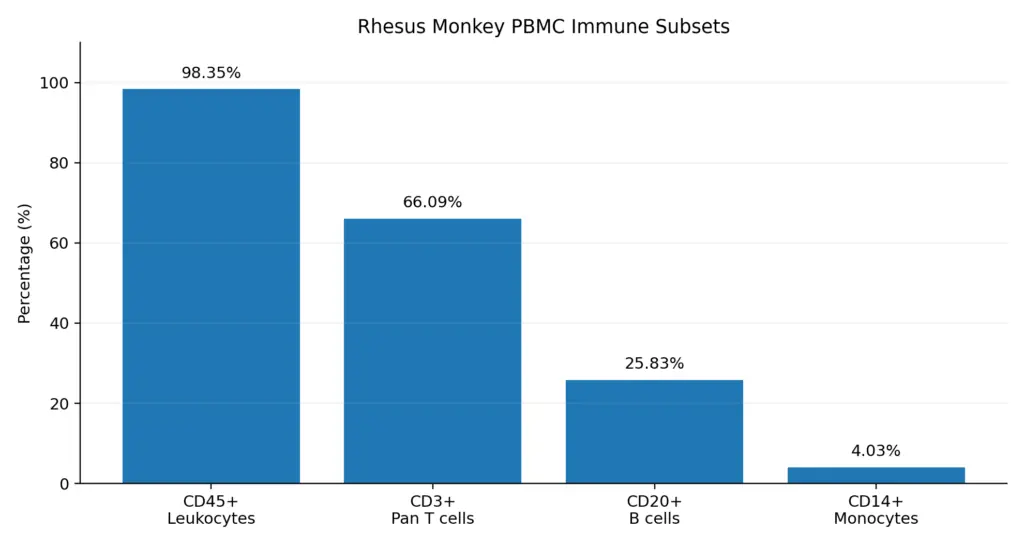
Figure 2. Key immune-cell subsets in the rhesus monkey PBMC characterization example: CD45+ 98.35%, CD3+ 66.09%, CD20+ 25.83%, and CD14+ 4.03%.
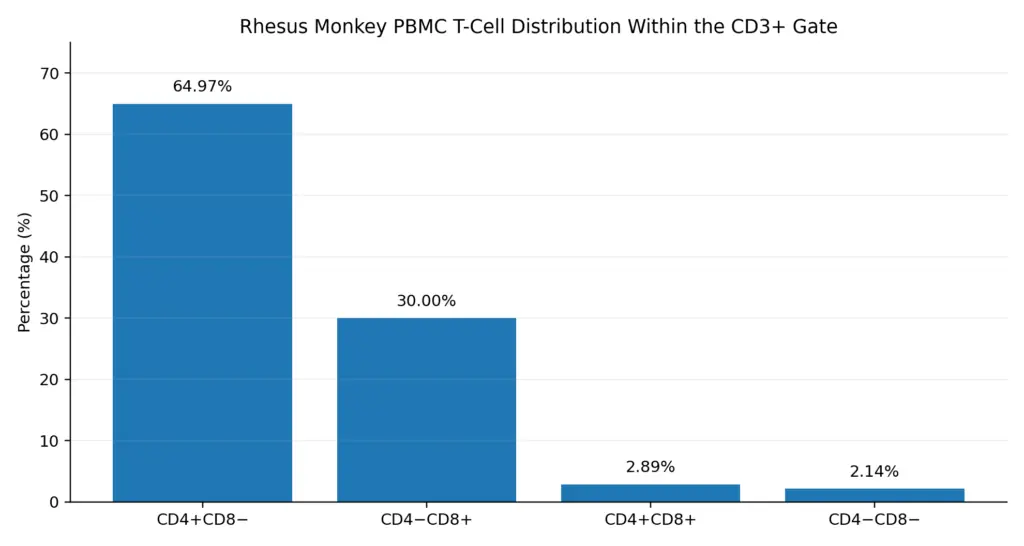
Figure 3. T-cell distribution within the CD3+ gate in the rhesus monkey PBMC characterization example: CD4+CD8− 64.97%, CD4−CD8+ 30.00%, CD4+CD8+ 2.89%, and CD4−CD8− 2.14%.
MileCell’s animal PBMC portfolio spans multiple species commonly used in immunology and translational research. Each listed PBMC product entry is supplied at 10 million cells, providing a practical starting point for panel development, control setup, and repeat-study planning.
| Category | Cat. No. | Product Description | Size |
|---|---|---|---|
| Mouse PBMCs | mPB010C-CB | C57BL/6N Mouse Peripheral Blood Mononuclear Cells (PBMCs) | 10 million |
| Mouse PBMCs | mPB010C-BA | BALB/c Mouse Peripheral Blood Mononuclear Cells (PBMCs) | 10 million |
| Mouse PBMCs | mPB010C-CD | CD-1 Mouse Peripheral Blood Mononuclear Cells (PBMCs) | 10 million |
| Rat PBMCs | rPB010C-SD | SD Rat Peripheral Blood Mononuclear Cells (PBMCs) | 10 million |
| Rat PBMCs | rPB010C-WH | Wistar Han Rat Peripheral Blood Mononuclear Cells (PBMCs) | 10 million |
| Rat PBMCs | rPB010C-LW | Lewis Rat Peripheral Blood Mononuclear Cells (PBMCs) | 10 million |
| Monkey PBMCs | cmPB010C | Cynomolgus Monkey Peripheral Blood Mononuclear Cells (PBMCs) | 10 million |
| Monkey PBMCs | rmPB010C | Rhesus Monkey Peripheral Blood Mononuclear Cells (PBMCs) | 10 million |
| Other Species PBMCs | dPB010C-BE | Beagle Dog Peripheral Blood Mononuclear Cells (PBMCs) | 10 million |
| Other Species PBMCs | pPB010C-BP | Bama Minipig Peripheral Blood Mononuclear Cells (PBMCs) | 10 million |
| Other Species PBMCs | pPB010C-LP | Landrace Pig Peripheral Blood Mononuclear Cells (PBMCs) | 10 million |
| Other Species PBMCs | rbPB010C-NR | New Zealand Rabbit Peripheral Blood Mononuclear Cells (PBMCs) | 10 million |
| Other Species PBMCs | fcPB010C-FC | Felis Catus Peripheral Blood Mononuclear Cells (PBMCs) | 10 million |
| Other Species PBMCs | alPB010C | Alpaca Peripheral Blood Mononuclear Cells (PBMCs) | 10 million |
For researchers building PBMC flow-cytometry workflows across animal models, MileCell combines practical supply options with research-use features that matter in daily work: high post-thaw viability, rigorous QC, reliable lot consistency, comprehensive species coverage, and customizable sourcing options. That combination can make it easier to move from cell procurement to interpretable immune profiling with fewer uncertainties.
If your study needs a mixed PBMC preparation today but may require defined subsets tomorrow, MileCell’s custom immune-cell isolation capabilities also make the workflow more scalable. That is particularly useful for teams progressing from broad screening into mechanism-focused follow-up studies.
It shows how a PBMC sample is distributed across marker-defined immune populations such as leukocytes, T cells, B cells, monocytes, and T-cell subsets.
The listed PBMC products include mouse, rat, cynomolgus monkey, rhesus monkey, beagle dog, bama minipig, landrace pig, New Zealand rabbit, felis catus, and alpaca sources.
Each listed PBMC product entry is supplied at 10 million cells.
The characterization example shows CD45+ leukocytes at 98.35%, CD3+ T cells at 66.09%, CD20+ B cells at 25.83%, and CD14+ monocytes at 4.03%, along with CD4/CD8 T-cell subset distribution inside the CD3+ gate.
Yes. The portfolio states that custom cell-isolation services are available for immune-cell subtypes such as CD3/CD4/CD8, CD14, CD19, and CD56.
Because it helps verify that the immune populations relevant to the study are present at interpretable levels before phenotyping, stimulation, or functional testing begins.
PBMC subpopulation profiling by flow cytometry gives researchers a more informative starting point for immune studies. Rather than treating PBMCs as a single undifferentiated input, profiling reveals how the sample is composed and how that composition may influence phenotyping, panel design, and downstream interpretation.
MileCell’s animal PBMC portfolio combines broad species coverage with high post-thaw viability, rigorous QC, reliable lot consistency, and customizable sourcing options. For teams building or expanding PBMC flow-cytometry workflows, that makes it easier to align cell supply with study design. If you are planning immune profiling, contact MileCell to discuss the right PBMC source, current availability, or custom immune-cell isolation options for your next project.
Need animal PBMCs for flow cytometry, immune profiling, or subset-specific studies? Explore MileCell’s Animal Immune Cells portfolio, request current lot information, or contact the team to discuss species selection, batch planning, and custom immune-cell isolation.