
Choosing mouse, rat, dog or monkey hepatocytes is not simply a question of which animal model is “closest” to the intended application. The useful choice depends on the species already relevant to the study, the endpoint being measured, the culture format, and the qualification data available for the exact material being considered.
MileCell offers primary suspension and plateable hepatocytes across these four species, with defined strain or breed, gender, donor format, qualification type and catalog number. The available functional examples span CD-1 mouse metabolism, SD rat sandwich culture and cynomolgus monkey spheroid and ASGPR studies. These are distinct demonstrations—not a head-to-head ranking of species.
For a metabolism or uptake experiment, a qualified suspension format and pathway-relevant activity data may be the priority. For attachment-dependent models, hepatobiliary transport or more extended culture designs, plateable cells may be the more appropriate starting point. When the assay involves 3D spheroids or ASGPR expression, format-specific functional evidence becomes particularly important.
| Study objective | Relevant product format | Documented example |
|---|---|---|
| Drug metabolism and uptake | Suspension hepatocytes | CD-1 mouse: Phase I/II enzyme activity and substrate stability |
| Sandwich culture and bile canaliculi | Plateable hepatocytes | SD rat: day-3 sandwich culture and CDFDA staining |
| 3D spheroid formation | Plateable hepatocytes | Cynomolgus monkey: spheroids observed through day 8 |
| ASGPR-related assessment | Plateable hepatocytes | Cynomolgus monkey: images at 4 h and 12 h post-recovery |
| Interpretation principle. Use the specific experimental evidence to select and qualify a model. A result demonstrated in one species or format should not be assumed for another without supporting lot-level information. |
|---|
The mouse portfolio includes C57BL/6N, C57BL/6JNifdc, CD-1, BALB/c, BALB/c Nude and M-NSG strains. The listed suspension products are pooled and metabolism qualified; the plateable entries are pooled and plateable qualified. Male, female and mixed-gender options are listed for these mouse strain families. The illustrated entries have a size of 5 million cells.
For metabolism-focused screening, the most directly documented example is CD-1 mouse suspension hepatocytes. Metabolic activity was measured after thawing at 37°C and 0.5 × 10⁶ cells/mL using LC-MS/MS, with results reported in pmol/min/10⁶ cells. Five lots—CD-1477, CD-1488, CD-1499, CD-1500 and CD-1511—are shown for Phase I and Phase II endpoints.
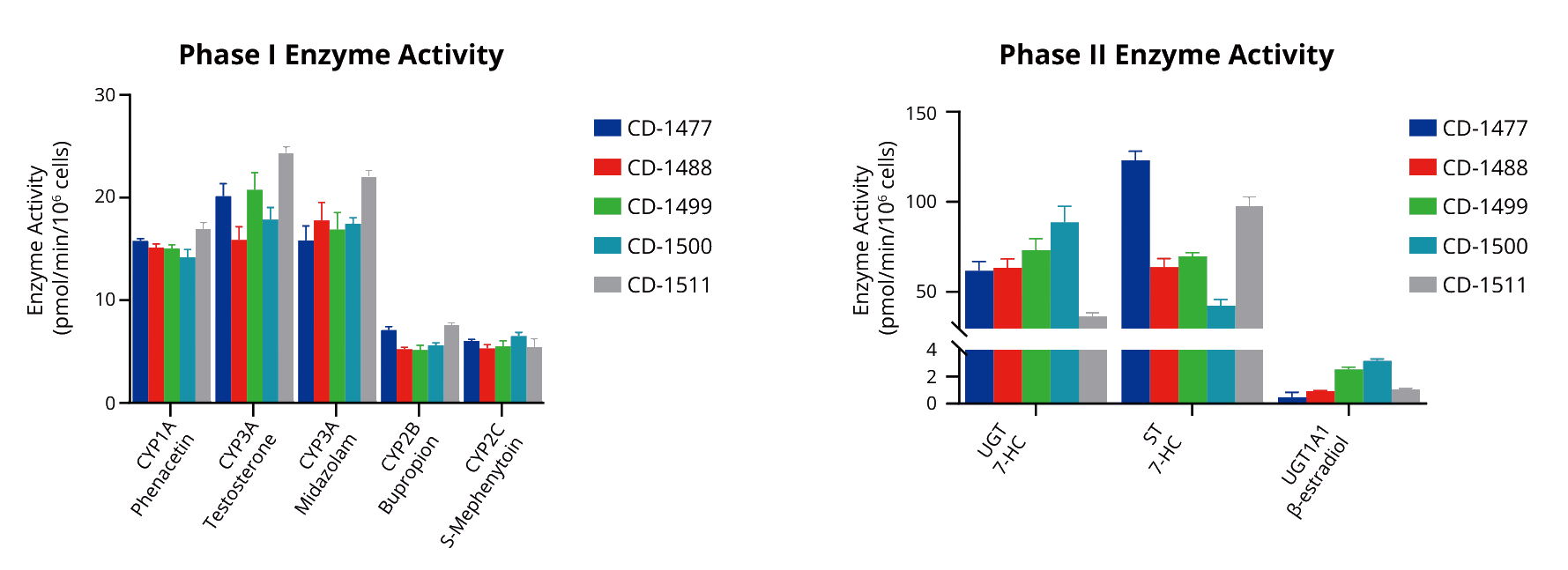
Figure 1. Phase I and Phase II activity in five CD-1 mouse suspension hepatocyte lots. Readouts include CYP1A/phenacetin, CYP3A/testosterone and midazolam, CYP2B/bupropion, CYP2C/S-mephenytoin, UGT/7-HC, ST/7-HC and UGT1A1/β-estradiol. Conditions: 37°C, 0.5 × 10⁶ cells/mL; LC-MS/MS; pmol/min/10⁶ cells.
Substrate-depletion profiles are also available for 7-hydroxycoumarin and verapamil, each tested at 1 μM. The curves track the percentage remaining over a 120-minute incubation. These results support discussion of the CD-1 mouse model for relevant metabolism workflows, but they do not establish comparative performance against rat, dog or monkey hepatocytes.
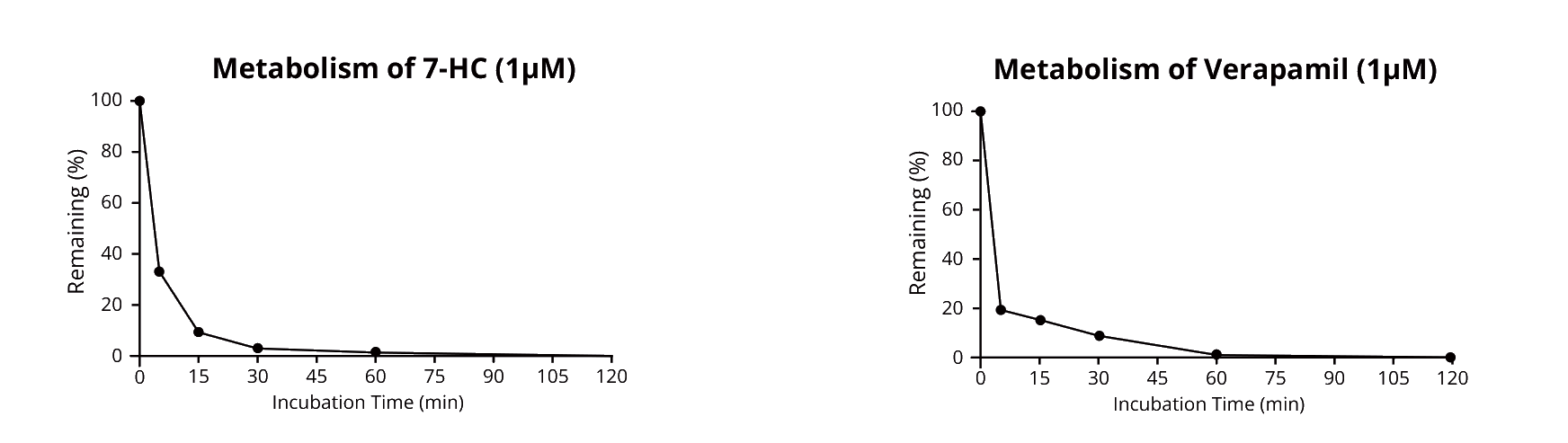
Figure 2. Metabolic stability of 1 μM 7-hydroxycoumarin and 1 μM verapamil in CD-1 mouse suspension hepatocytes. Samples were taken at multiple time points and analyzed by LC-MS/MS; curves are retained as presented, without estimated intermediate values.
The rat portfolio lists Sprague Dawley (SD), Wistar, Wistar Han, Brown Norway and Lewis strains. Each appears in the suspension and plateable selections, including male, female and mixed-gender pooled entries at a listed size of 5 million cells.
The SD rat plateable example provides a specific rationale for considering this format in hepatobiliary transport work. In a sandwich-culture demonstration, the cell layer showed 100% confluency and bile canaliculi on day 3; CDFDA staining was used to visualize uptake into bile canaliculi. This example is relevant to selecting a model for uptake/efflux transporter and hepatobiliary studies, but it is not a general guarantee for every rat lot.
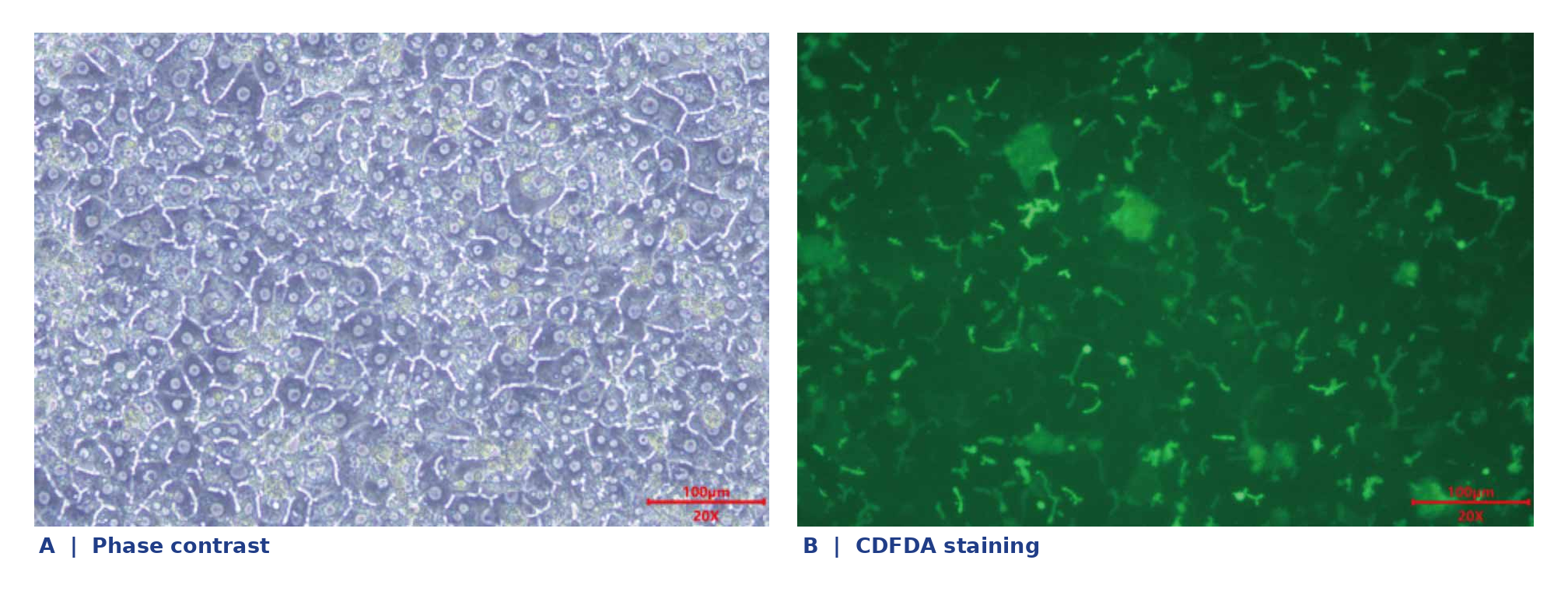
Figure 3. SD rat plateable hepatocytes in sandwich culture. A: day-3 morphology and bile-canalicular structures; B: CDFDA staining of bile canaliculi. The 100% confluency observation refers to the illustrated experiment.
For projects built around a canine comparison or an established Beagle study design, MileCell lists Beagle dog suspension and plateable hepatocytes. The suspension options include pooled male, female and mixed-gender entries; the plateable options distinguish male and female single-donor products from a mixed-gender pooled product. Each illustrated catalog entry is listed at 5 million cells.
The available product information supports selection by species, culture format and donor configuration. It does not include a dog-specific enzyme-activity chart or a four-species comparative metabolism experiment. Researchers should therefore request the functional characterization relevant to the chosen assay rather than extrapolating mouse or monkey findings to Beagle hepatocytes.
The monkey entries cover cynomolgus and rhesus hepatocytes. For both species, the listed suspension products are male, pooled and metabolism qualified; the plateable products are male, single-donor and plateable qualified. The illustrated product size is 5 million cells.
Cynomolgus monkey hepatocytes are accompanied by 3D spheroid data. A culture initiated with 3,000 cells formed spheroids by day 8, with a reported diameter of approximately 250–300 μm. The micrographs show the progression on days 4, 6, 7 and 8. These observations make the cynomolgus plateable model a relevant product to investigate where a spheroid workflow is planned.
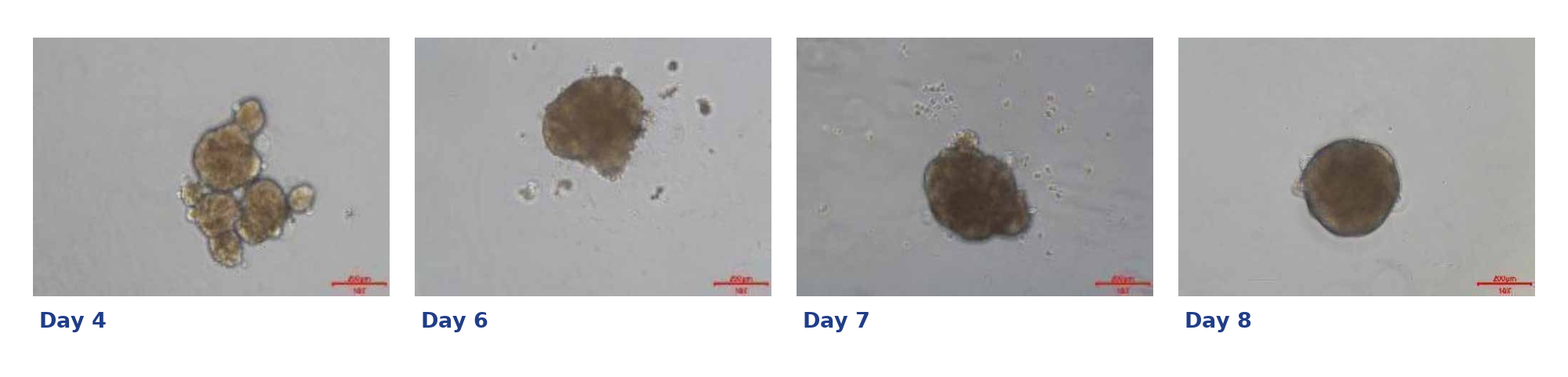
Figure 4. Cynomolgus monkey hepatocyte 3D spheroid images at days 4, 6, 7 and 8. The reported day-8 diameter is approximately 250–300 μm from an example initiated with 3,000 cells.
A second cynomolgus dataset shows phase-contrast and fluorescent images after 4 and 12 hours of post-recovery culture. ASGPR expression decreased as culture time increased in this example. Investigators studying receptor-related biology or GalNAc-associated targeting should therefore consider sampling time as well as the selected cell lot.
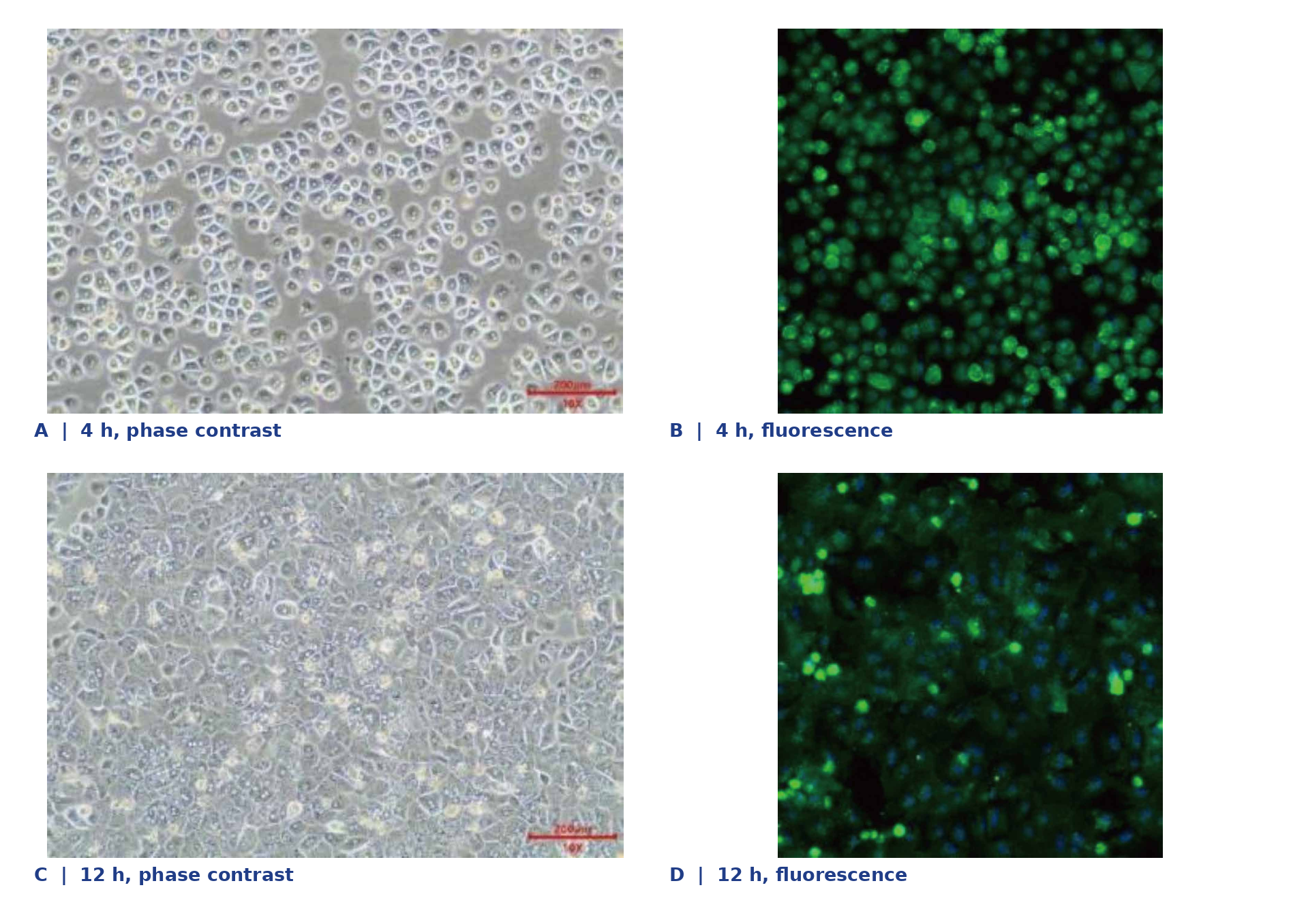
Figure 5. Cynomolgus monkey plateable hepatocytes: phase-contrast and fluorescent images at 4 h (A, B) and 12 h (C, D) post-recovery. The observed ASGPR signal decreases with culture time in the illustrated experiment.
| Species | Strains / breed shown | Documented functional example |
|---|---|---|
| Mouse | C57BL/6N, C57BL/6JNifdc, CD-1, BALB/c, BALB/c Nude, M-NSG | CD-1 suspension: CYP/UGT/ST activity; 7-HC and verapamil stability |
| Rat | SD, Wistar, Wistar Han, Brown Norway, Lewis | SD plateable: sandwich culture and CDFDA staining |
| Dog | Beagle | Portfolio entries shown; request assay-matched qualification |
| Monkey | Cynomolgus, Rhesus | Cynomolgus plateable: spheroids and ASGPR imaging |
This comparison describes available examples and catalog options; it should not be interpreted as a quantitative cross-species potency, clearance, activity or viability comparison. Where differences between species are central to the question, evaluate matched lots under a consistent study protocol.
The following matched examples illustrate how species and format map to distinct catalog numbers. Each entry below is listed at 5 million cells. Confirm the exact gender, donor configuration and qualification required for your experiment before ordering.
| Species / example | Suspension SKU | Plateable SKU |
|---|---|---|
| Mouse / male CD-1 | CMH-100CD-SQ | CMH-100CDP-PQ |
| Rat / male SD | CRH-100SD-SQ | CRH-100SDP-PQ |
| Dog / male Beagle | CDH-100BE-SQ | CDH-100BES-PQ |
| Monkey / male Cynomolgus | CCH-100CYP-SQ | CCH-100CYS-PQ |
| Monkey / male Rhesus | CCH-100RMP-SQ | CCH-100RMS-PQ |
In these examples, suspension products are pooled and metabolism qualified. The shown mouse and rat plateable products are pooled; the shown male Beagle, cynomolgus and rhesus plateable products are single-donor and plateable qualified. Other gender configurations vary by the specific catalog entry.
MileCell describes quality-control and post-thaw functional characterization before release of cryopreserved suspension lots. Its hepatocyte offerings also include customizable species, gender, pack-size, batch-size and cell-specification options. Organization-level ISO 9001, ISO 14001 and ISO 45001 marks are displayed in its materials; request any study-specific or lot-specific compliance documentation needed for your work.
There is no universal best species established by the available data. CD-1 mouse suspension hepatocytes have illustrated CYP and other enzyme-activity readouts; other species should be evaluated against the intended study pathway and lot-level qualification.
Yes. Both product formats are listed for all four species, with specific strains, breeds, donor configurations and catalog numbers.
An SD rat example demonstrates a day-3 sandwich culture with bile canaliculi and CDFDA staining. Confirm the appropriate assay conditions and selected lot before use.
No such equivalence is demonstrated. The illustrated spheroid and ASGPR experiments concern cynomolgus monkey cells; results should not be generalized automatically to rhesus cells or all lots.
Request availability for the exact SKU, donor configuration, relevant functional qualification, and the intended pack size or cell specification. Discuss any requirements unique to your experimental protocol.
Mouse, rat, dog and monkey hepatocytes offer distinct catalog choices, but selecting the right product begins with the experimental question. CD-1 mouse metabolic characterization, SD rat sandwich-culture evidence and cynomolgus monkey 3D/ASGPR examples provide useful starting points for model selection—without claiming that one species outperforms the others.
| Explore MileCell primary hepatocytes. Looking for an animal hepatocyte model that matches your ADME or hepatotoxicity workflow? Contact the MileCell team to discuss species, format, available qualification data and current product options. Info@milecell-bio.com | www.milecell-bio.com |
|---|