
A primary hepatocyte assay can produce a clean-looking dataset while the underlying cell population is struggling to recover. That is why hepatocyte viability is more than a routine post-thaw quality checkpoint: it is part of the context needed to interpret metabolism, uptake, transporter function, and hepatotoxicity readouts in ADMET research.
Yet a viable cell is not automatically a functionally qualified cell. A defensible assessment also considers enzyme activity, metabolic stability, attachment, morphology, and the culture format used for the intended endpoint. This guide connects those decisions to real characterization examples from MileCell primary hepatocytes, without treating viability as a substitute for functional evidence.
| The key distinctionPost-thaw viability describes cell recovery at a defined assessment point. ADMET suitability depends on whether the recovered cells retain the function required by the specific assay. These questions should be evaluated together, not treated as interchangeable. |
|---|
Cryopreserved primary hepatocytes must survive thawing and, depending on the workflow, either enter an immediate suspension incubation or recover sufficiently to attach and function in culture. Poor recovery can change the effective population available for a study. The consequences depend on whether results are interpreted per nominal cell number, per viable cell, over an incubation period, or within an attachment-dependent model.
Viability should therefore be read alongside lot-specific functional characterization. MileCell identifies high post-thaw viability as a feature of both its suspension and plateable hepatocyte lines, while separately describing metabolic, transporter, spheroid, and receptor-related qualification approaches. No single universal numerical viability cutoff is specified for these products.
In suspension incubations, the amount of functional hepatocyte material affects how readily a substrate is metabolized. If sample preparation changes the number of active cells, an apparent difference in substrate disappearance may reflect the cell preparation, the experimental design, or the tested compound. A time-course readout should therefore be evaluated together with the effective cell population and relevant metabolism qualification.
Hepatocyte metabolic competence encompasses more than a live/dead readout. Enzyme-specific readouts help determine whether the pathways of interest remain measurable. MileCell characterizes CYP, SULT, and UGT activities and presents a five-lot CD-1 mouse example with both Phase I and Phase II results. Those data demonstrate enzyme activity, but do not quantify how a given viability percentage changes enzyme activity.
For plateable hepatocytes, successful attachment and culture architecture are essential to interpreting certain endpoints. In sandwich culture, cells re-establish polarity and bile canaliculi-like networks that support transporter and hepatobiliary studies. A cell preparation may appear recovered, but an assay requiring those structures still needs morphology and transporter-associated evidence.
DILI studies can be affected by cell condition before a candidate compound is introduced. Attachment, baseline morphology, continued metabolic function, and the selected exposure period should be considered when distinguishing compound-related findings from a compromised model. Different culture formats address different experimental needs; one viability result cannot establish suitability for every endpoint.
MileCell evaluated five CD-1 mouse suspension hepatocyte lots: CD-1477, CD-1488, CD-1499, CD-1500, and CD-1511. Thawed cells were incubated at 37°C at 0.5 × 10⁶ cells/mL, and activities were measured by LC-MS/MS in pmol/min/10⁶ cells. The panel includes CYP1A, CYP3A, CYP2B, CYP2C, UGT, ST, and UGT1A1 readouts. These are pathway-specific results, not measurements of viability-dependent changes.
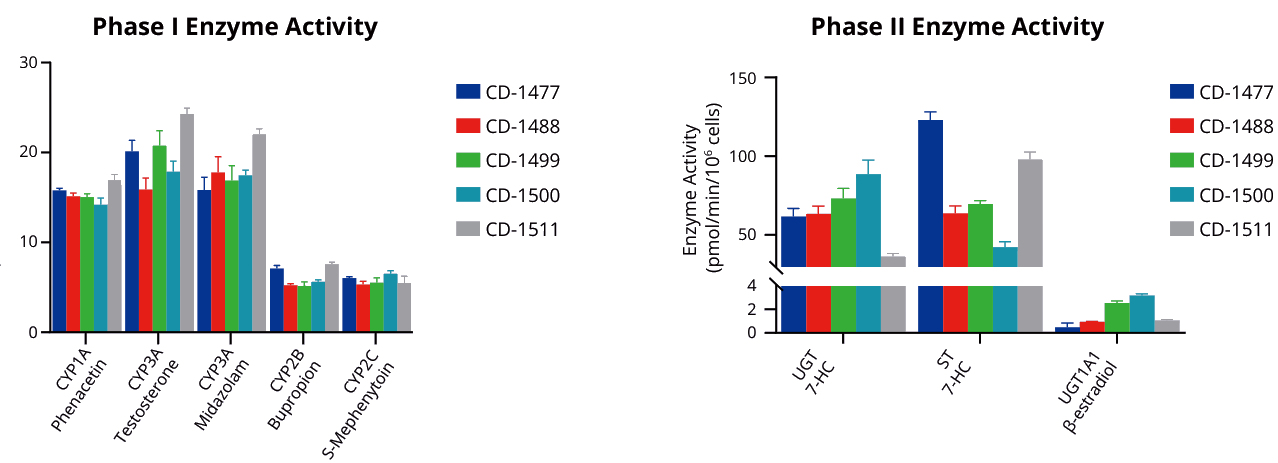
Figure 1. Phase I and Phase II metabolic activity measured in five CD-1 mouse suspension hepatocyte lots. Conditions: 37°C, 0.5 × 10⁶ cells/mL; LC-MS/MS; pmol/min/10⁶ cells. Original axis scales, lot labels, substrates and data are preserved.
A separate CD-1 mouse suspension hepatocyte example follows 1 μM 7-hydroxycoumarin (7-HC) and 1 μM verapamil. Samples were collected over the incubation period and analyzed by LC-MS/MS. The plots show percentage remaining through 120 minutes; no additional clearance constants or inferred time-point values are introduced here.
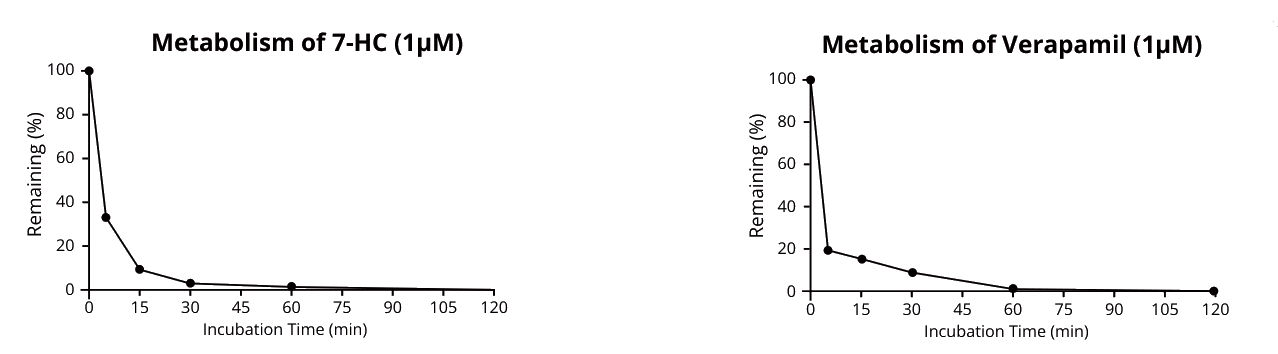
Figure 2. Percentage remaining over time for 1 μM 7-HC and 1 μM verapamil in CD-1 mouse suspension hepatocytes. Original time points and curves are retained; the plotting background has been standardized to white.
Interpretation: metabolic stability and enzyme activity provide meaningful functional context to accompany cell-recovery information. They do not, by themselves, establish a numerical correlation between post-thaw viability and metabolic performance.
Plateable hepatocytes are used for attachment-dependent applications including hepatotoxicity assessment, hepatic drug metabolism, transporter investigations, and hepatobiliary excretion studies. Morphological integrity and attachment efficiency are therefore distinct criteria from suspension-cell recovery. Sandwich culture uses collagen I or Matrigel around the hepatocyte monolayer to support polarity and bile canaliculi-like networks.
In a reported SD rat plateable hepatocyte sandwich-culture example, cells achieved 100% confluency and formed bile canaliculi on day 3. CDFDA staining was observed in the canalicular structures. This evidence is directly relevant to culture architecture and transporter-related qualification. Importantly, 100% confluency is not a measured 100% viability result.
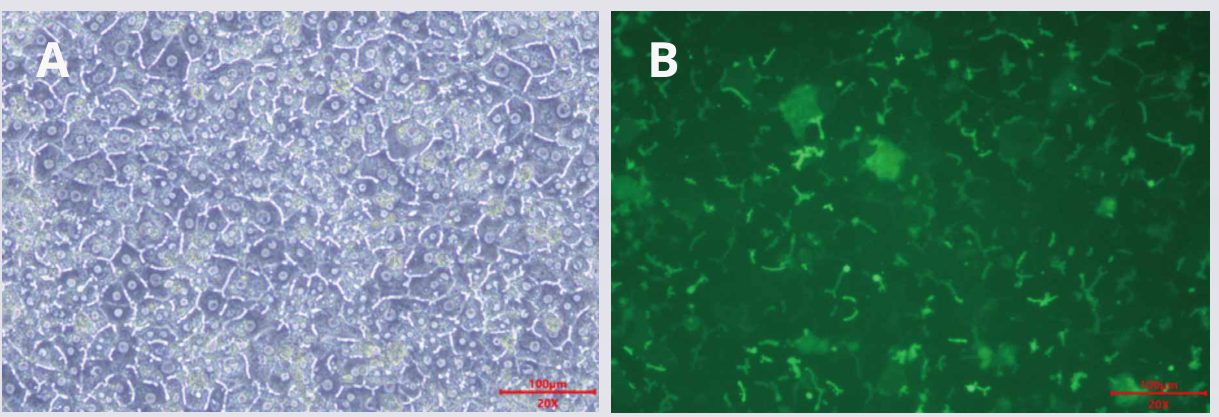
Figure 3. SD rat plateable hepatocytes in sandwich culture. (A) Day-3 morphology with 100% confluency and bile canaliculi; (B) CDFDA staining associated with bile canaliculi. Original microscopy images and scale bars are retained.
The three-dimensional format offers another route to sustained hepatocyte culture. In the documented cynomolgus monkey example, spheroids were initiated with 3,000 cells and assessed over days 4, 6, 7, and 8. Following 8 days of culture, the spheroid diameter was approximately 250–300 μm. This describes spheroid formation and morphology, not a quantified comparison of viability or ADMET assay outcomes.
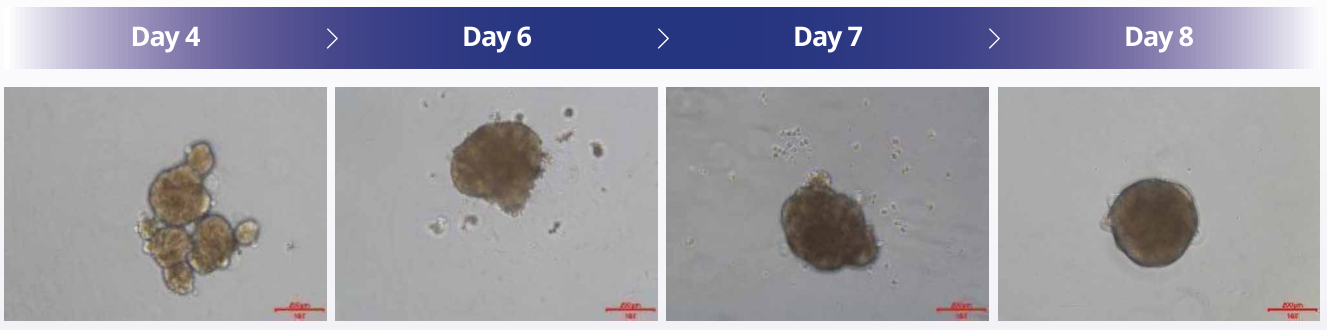
Figure 4. Cynomolgus monkey hepatocyte spheroid development on days 4, 6, 7, and 8. Starting cell number: 3,000; approximate diameter after day 8: 250–300 μm. Images and the experimental timeline are preserved.
A useful example comes from ASGPR qualification of cynomolgus monkey plateable hepatocytes. Phase-contrast and fluorescence images were collected after 4 and 12 hours of post-recovery culture. The recorded ASGPR expression decreased with longer culture time. That time-dependent observation reinforces a practical principle: cell appearance or recovery alone does not determine whether a particular molecular target is maintained at the level needed for an assay.
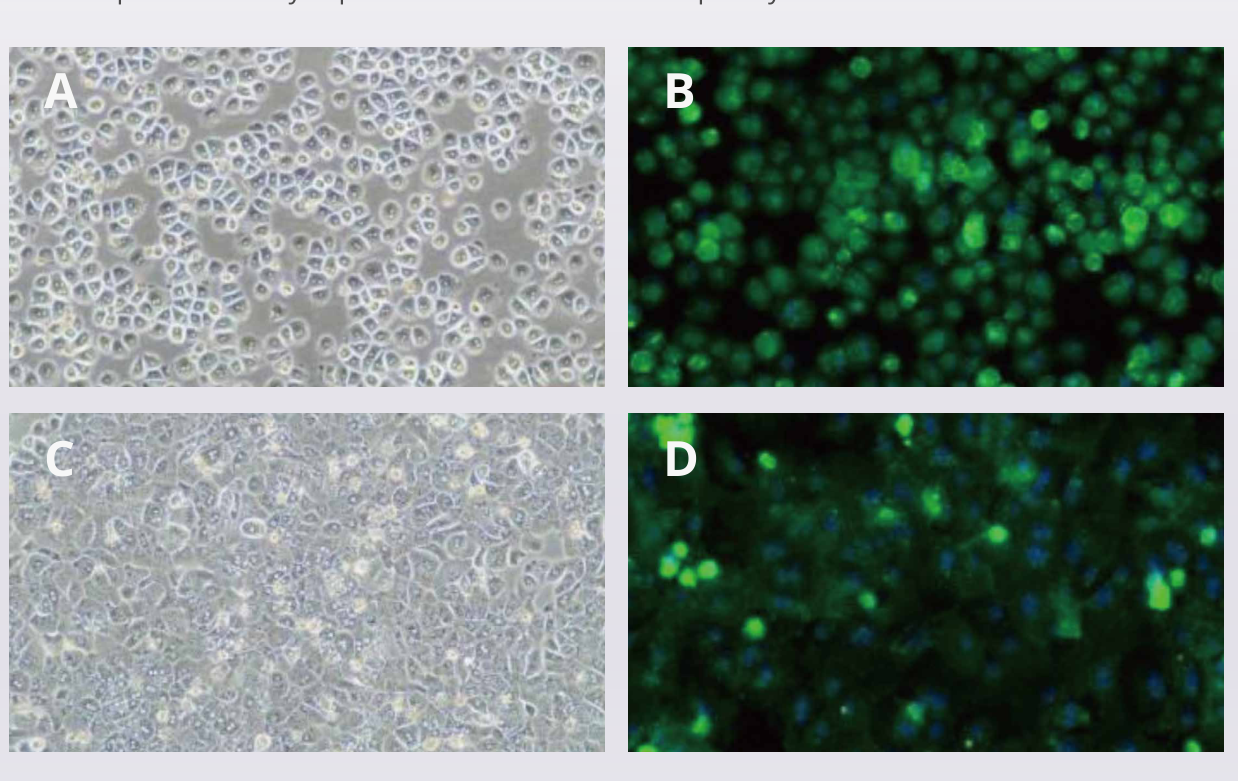
Figure 5. Phase-contrast and fluorescence images of cynomolgus monkey plateable hepatocytes at 4 h (A, B) and 12 h (C, D) after recovery. ASGPR expression was observed to decrease with longer culture time. Original panel labels and microscopy content are preserved.
MileCell offers cryopreserved primary suspension hepatocytes for metabolism and uptake studies and plateable hepatocytes for attachment-dependent applications. Available qualification options include metabolism, transporter, 3D spheroid, and ASGPR-related characterization, with selection based on the application. Species, gender, donor configuration, pack size, batch size, and cell specifications can be discussed for project requirements.
| Product / qualification | Cat. No. | Listed size |
|---|---|---|
| Male CD-1 Mouse Hepatocytes — pooled, suspension and metabolism qualified | CMH-100CD-SQ | 5 million |
| Male SD Rat Hepatocytes — pooled, suspension and metabolism qualified | CRH-100SD-SQ | 5 million |
| Male SD Rat Hepatocytes — pooled, plateable qualified | CRH-100SDP-PQ | 5 million |
| Male Beagle Dog Hepatocytes — pooled, suspension and metabolism qualified | CDH-100BE-SQ | 5 million |
| Male Cynomolgus Monkey Hepatocytes — pooled, suspension and metabolism qualified | CCH-100CYP-SQ | 5 million |
Product qualification and donor configuration differ by catalog entry. Confirm the relevant lot documentation and suitability for the planned endpoint before ordering.
No. Viability indicates recovery of living cells, whereas CYP measurements address pathway-specific metabolic activity. A study requiring CYP function should review the relevant enzymatic characterization and assay conditions.
Changes in the functional hepatocyte population may influence apparent substrate depletion. Interpret time-course data together with the cell concentration, incubation settings, and available metabolic characterization, rather than assuming a result represents compound properties alone.
No. Confluency describes the area occupied by an attached cell layer. The SD rat example reports 100% confluency and canalicular formation on day 3; it does not report 100% viability.
No. Suspension metabolism assays, sandwich-culture transporter studies, and spheroid workflows have different requirements. Select the format and evidence that correspond to the intended endpoint.
A practical ADMET evaluation does not stop at a single post-thaw measurement. The combination of recovery information, functional pathway readouts, and format-specific qualification is more informative than any single indicator. For metabolism, that means examining the relevant CYP and Phase II measurements alongside substrate-stability behavior. For plateable systems, it means reviewing attachment, morphology, polarity, and transport-associated images. For longer culture and targeted delivery studies, spheroid behavior or receptor expression may also be pertinent.
The featured characterization examples demonstrate these different dimensions of product suitability. None represents a controlled experiment isolating post-thaw viability as the cause of a particular ADMET outcome. Avoid assigning a universal viability threshold or a numerical effect size without matched study-specific evidence.
Hepatocyte viability matters because the quality of the recovered cell population shapes the context in which ADMET measurements are generated. However, viable cells are only the starting point. Reliable interpretation also depends on metabolic competence, the appropriate culture format, and qualification matched to the biological question. Bringing these elements together helps researchers design more interpretable in vitro liver studies.
| Explore MileCell Primary HepatocytesPlanning a drug metabolism, DILI, hepatobiliary transport, or 3D hepatocyte study? Contact MileCell to discuss species and donor options, available lot-level post-thaw quality information, relevant functional characterization, and current product availability. Email: Info@milecell-bio.com | Web: www.milecell-bio.com |
|---|