
Choosing how to isolate human T cells is about more than recovering a CD3-positive fraction. The isolation approach can determine whether target cells are directly labeled and whether subsequent measurements can be interpreted with confidence. For a workflow involving T cell characterization, culture, or functional analysis, matching the selection strategy to the assay is essential.
CD3 MicroBeads provide an antibody-guided route to positive magnetic enrichment of Pan T cells. This guide explains the principle, contrasts direct CD3 capture with untouched-cell selection, and outlines practical quality checks without treating platform characteristics as measured CD3-specific outcomes.
CD3 is associated with the T cell receptor complex and is widely used to identify mature T lymphocytes. Unlike CD4- or CD8-directed approaches that target defined T cell subsets, CD3-directed selection is intended to enrich a broad CD3-expressing T cell population. MileCell MagSep™ CD3 MicroBeads, Human (Cat. No. AB0003) are listed for positive selection of Pan T cells.
The MagSep™ platform uses 100 nm superparamagnetic particles coupled to monoclonal antibodies at their surface. When target cells bind the particles, a magnetic field can separate the labeled population from other cells in a mixed suspension.
Positive selection labels the desired target population. After antibody-conjugated magnetic particles bind CD3-expressing cells, magnetic retention separates those cells from the unlabeled fraction. The recovered, magnetically selected fraction is enriched for the marker-positive population. Negative selection takes the opposite approach: unwanted cells are magnetically labeled and removed while intended target cells remain unlabeled by the selection reagent.
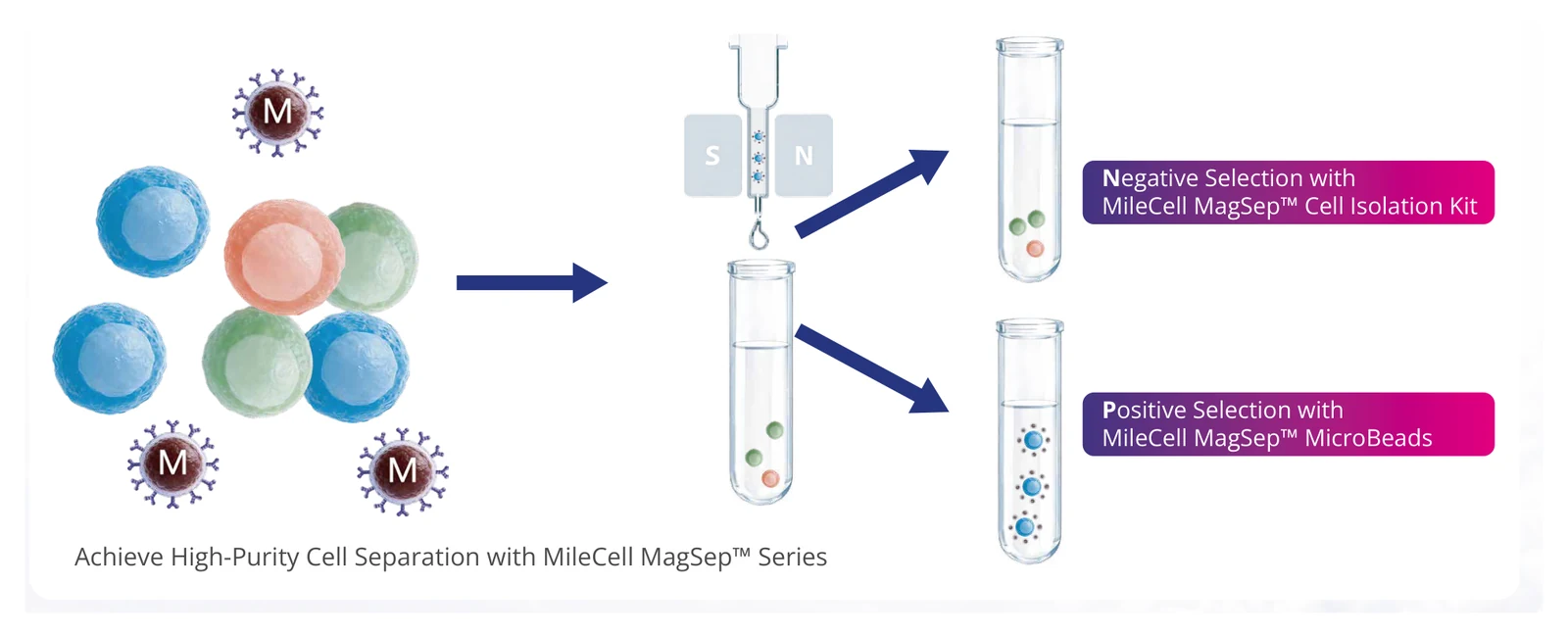
The schematic conveys the separation principle, not a validated CD3 protocol. Use the CD3 product-specific instructions for sample preparation, reagent quantities, incubation, separation and washing parameters.
MileCell lists both a CD3 positive-selection reagent and a distinct Pan T negative-selection kit. The two methods answer different experimental questions rather than providing interchangeable forms of the same preparation.
| Decision factor | CD3-positive selection | Pan T negative selection |
|---|---|---|
| MileCell product | CD3 MicroBeads, Human / AB0003 | Pan T Cell Isolation Kit, Human / AB0053 |
| Cells labeled by separation reagents | Intended CD3-expressing T cells | Unwanted populations |
| Resulting target fraction | Enriched cells directly labeled during selection | Enriched cells intended to remain unlabeled |
| Method selection | Useful when CD3-directed capture suits the readout | Consider when direct CD3 labeling should be avoided |
Neither method should be assumed to deliver a specific purity or recovery figure without measurement in the intended sample. For sensitive studies, the appropriate strategy is the one demonstrated not to interfere with the downstream endpoint.
CD3 forms part of the signaling machinery associated with the T cell receptor. Antibody engagement of the TCR–CD3 complex can participate in signaling under suitable conditions [1,2]. This general immunology principle does not establish that MagSep™ CD3 MicroBeads activate T cells, nor does it prove that they never do. The antibody clone, labeling context, and specific downstream experiment all matter.
If an experiment examines early activation, TCR-mediated signaling, or changes in surface CD3 staining, include method-appropriate controls and verify marker detection after selection. When direct CD3 occupancy is a concern, consider the separately listed Pan T Cell Isolation Kit, Human (AB0053), which uses negative selection.
MagSep™ MicroBeads use 100 nm magnetic nanoparticles and emphasize minimal labeling. The stated design objective is to support cell viability and reduce functional interference. This is a platform feature, not a measured CD3-selected cell viability percentage or functional comparison.
The MagSep™ range is described as biodegradable, low-endotoxin, and residue-free, and is designed for integration with flow cytometry, in vitro culture, and single-cell sequencing. Suitability for a particular staining panel, culture setup, or molecular assay should still be verified before routine use.
MileCell highlights lot-to-lot consistency across the series and lists ISO 9001, ISO 14001 and ISO 45001 management systems. These designations are organizational management standards; they are not measurements of CD3-specific purity, recovery, or biological performance.
A useful evaluation plan distinguishes the identity of the enriched cells from the impact of the isolation procedure on their intended use:
A representative percentage from a different target-specific MicroBeads reagent cannot be treated as a performance specification for CD3 Pan T cell enrichment.
For researchers seeking marker-directed Pan T cell enrichment, MileCell MagSep™ CD3 MicroBeads, Human (AB0003) provide a positive-selection option built on the MagSep™ nanomagnetic separation platform. Its surface-conjugated monoclonal antibody approach and nanoscale particle design are intended to combine targeted magnetic handling with compatibility across common immune-cell research workflows.
Researchers who need an untouched target population can evaluate the complementary Pan T Cell Isolation Kit, Human (AB0053). Product selection should be based on the required marker definition and the assay in which the recovered cells will be used.
Planning CD3+ Pan T cell isolation? Explore the MileCell MagSep™ range at www.milecell-bio.com or contact Info@milecell-bio.com to request product-specific technical guidance and a quotation.
CD3 MicroBeads, Human are intended for Pan T cells. MileCell lists separate CD4 MicroBeads (AB0001) and CD8 MicroBeads (AB0002) for different marker-directed selections.
Consider a negative-selection strategy when direct CD3 labeling could complicate surface-marker detection or a signaling-sensitive assay. MileCell lists Pan T Cell Isolation Kit, Human (AB0053) for this approach.
No. Minimal labeling is a platform design feature, but preservation of a specific experimental endpoint requires appropriate functional controls.
Purity depends on the starting cell population and the validated workflow. Establish a CD3-specific purity value by analyzing the recovered cells, rather than adopting another target reagent’s result.
The MagSep™ series is designed for downstream compatibility with flow cytometry and in vitro culture. Confirm the CD3 detection strategy and assay-specific requirements in your own workflow.
CD3 MicroBeads for Pan T Cell Selection offer direct enrichment of human CD3-expressing T cells using antibody-guided magnetic separation. The relevant decision is not simply positive versus negative selection: it is whether the labeling strategy, sample characteristics, and downstream biology are aligned.
MileCell MagSep™ combines nanoscale superparamagnetic particles, target-specific MicroBeads, and a separate untouched Pan T cell isolation option. Characterize the actual selected population to turn that platform choice into reliable experimental results.