
The most useful monocyte isolation method is the one that selects the population relevant to the question being asked. A CD14-positive fraction can be appropriate for many human monocyte studies, but surface-marker expression, subset representation, and downstream functional testing should all guide the workflow.
MileCell MagSep™ CD14 MicroBeads, Human (Cat. No. AB0004) are designed for positive magnetic selection of CD14+ monocytes. This article explains marker-directed capture, its relationship to monocyte heterogeneity, and the practical checks that support interpretation of downstream results.
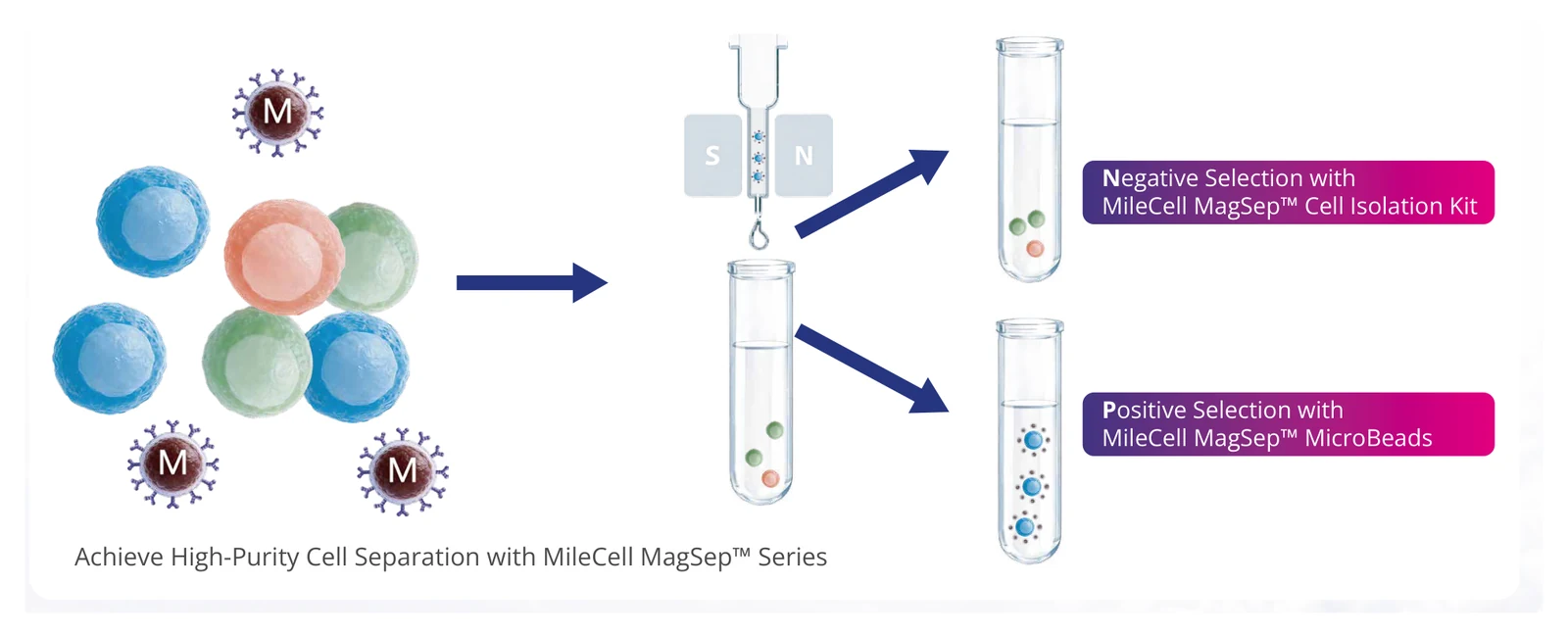
CD14 is a cell-surface marker commonly used to identify human monocytes. In positive magnetic selection, surface-conjugated monoclonal antibodies on magnetic particles bind cells expressing the target marker; a magnetic field retains the labeled fraction while other cells are separated. MagSep™ CD14 MicroBeads, Human are listed specifically for CD14+ monocytes.
CD14-directed enrichment is marker-defined. It should not be described as uniform recovery of every monocyte subset or as an independent guarantee of sample purity. Both target identity and the desired cellular composition should be verified after separation.
A cell suspension is labeled with a target-specific magnetic reagent. During magnetic separation, bound CD14-expressing cells are retained while nonretained cells are removed. The collected fraction is then used for an appropriate downstream assay. The exact labeling and separation conditions must follow the CD14 reagent’s product-specific operating instructions.
Human blood monocytes are commonly described as classical, intermediate, and nonclassical subsets based on CD14 and CD16 surface-expression patterns [1]. Their marker profiles are important when designing a CD14-directed experiment:
| Subset | Common CD14/CD16 phenotype | Interpretation for CD14 selection |
|---|---|---|
| Classical | CD14++ CD16− | High CD14 expression; confirm the actual recovered population. |
| Intermediate | CD14++ CD16+ | High CD14 expression; distinguish from classical cells using CD16. |
| Nonclassical | CD14+ CD16++ | Relatively lower CD14 expression; capture and representation cannot be presumed. |
These are established immunophenotypic classifications, not measured recovery characteristics of MagSep™ CD14 MicroBeads. In particular, a CD14-enriched preparation should not be labeled “all monocytes” without determining its cellular composition. Use a suitable flow-cytometry panel when subset distribution matters.
MileCell MagSep™ MicroBeads use 100 nm superparamagnetic nanoparticles coupled to monoclonal antibodies. The platform emphasizes minimal labeling to support viability and limit functional interference. Particle size describes the reagent design, not a CD14-specific viability or recovery result.
The MagSep™ product line is described as biodegradable, low-endotoxin, and residue-free, with designed compatibility for flow cytometry, in vitro culture, and single-cell sequencing. These attributes are relevant to monocyte studies, but a specific experimental readout should still be validated rather than assumed compatible.
CD14 participates in the innate immune recognition pathway associated with LPS and TLR4 [2]. Accordingly, when an experiment measures CD14 staining, LPS responsiveness, cytokine production, or other receptor-related biology, evaluate whether direct antigen labeling affects the planned readout. Studies of other CD14-based isolation procedures have reported method-dependent downstream responses [3], but those observations must not be generalized as measured effects of MagSep™ CD14 MicroBeads.
MileCell emphasizes lot-to-lot consistency and lists ISO 9001, ISO 14001 and ISO 45001 management systems. These descriptions concern platform quality and management practices, not guaranteed CD14-specific purity, recovery, or cell function.
Both approaches may be considered conceptually for monocyte preparation, but they differ in which cells are labeled. The MagSep™ range identifies CD14 MicroBeads, Human (AB0004) as a positive-selection product; it does not list a matched CD14 negative-selection kit.
| Decision factor | CD14 positive selection | Untouched-cell approach |
|---|---|---|
| Labeled population | Desired CD14-expressing cells | Unwanted cells targeted for depletion |
| Target fraction | Marker-directed enriched fraction, directly labeled | Unlabeled target fraction |
| Consider when | CD14 expression defines the population of interest | Avoiding target-marker labeling is important |
| Validation | Check subset profile and any CD14-dependent assay response | Check target identity and depletion specificity |
This is a comparison of selection principles, not a claim of comparable product-specific performance. The appropriate strategy depends on the study endpoint and what fraction of the starting sample must be represented.
After separation, evaluate the selected fraction rather than relying on a general platform description:
For customer-facing results, report CD14-specific experimental outcomes only when the sample source, separation conditions, gating method and underlying measurements can be verified.
MagSep™ CD14 MicroBeads, Human (AB0004) provide a marker-directed positive magnetic selection option for human CD14+ monocytes. The product belongs to MileCell’s broader MicroBeads range, which also includes CD3 (AB0003), CD4 (AB0001) and CD8 (AB0002) positive-selection reagents for their respective target cells.
By combining antibody-guided enrichment with nanoscale particles and low-endotoxin material design, MagSep™ offers a workflow option for immunology and immuno-oncology studies. Product selection should still be based on the required monocyte phenotype and the conditions of the subsequent assay.
Planning CD14+ monocyte enrichment? Explore the MileCell MagSep™ range at www.milecell-bio.com or contact Info@milecell-bio.com to request product-specific technical guidance and a quotation.
That cannot be assumed. CD14 expression differs across commonly recognized monocyte subsets, so use an appropriate CD14/CD16 characterization strategy when subset balance matters.
Positive selection directly labels CD14-expressing cells. Negative selection instead labels unwanted cells and leaves the intended target fraction unlabeled. No matched CD14 negative-selection kit is listed in the MagSep™ range.
The MagSep™ platform is intended for compatibility with these applications. Confirm whether CD14 detection or the downstream biological assay is sensitive to the labeling method.
A universal purity value should not be assumed. Quantify purity and viability using the intended starting material and validated isolation conditions.
Not necessarily. CD14 is biologically relevant to innate immune signaling, so functional assays should include suitable controls. Published observations involving other separation methods are not performance findings for MagSep™ CD14 MicroBeads.
The MileCell product is CD14 MicroBeads, Human, Cat. No. AB0004, for positive selection of CD14+ monocytes.
CD14 MicroBeads for monocyte isolation enable targeted magnetic enrichment of CD14-expressing human cells. The key to useful downstream data is recognizing what the marker identifies, verifying which monocyte subsets are recovered, and checking the sensitivity of the final assay to direct antigen labeling.
MileCell MagSep™ provides a 100 nm nanomagnetic positive-selection option with documented platform design characteristics. Keep the experiment centered on the population and readout you need, and measure performance in the real CD14-selected preparation.