
2026.02.13
CD14+ monocytes are indispensable to immune function, serving as both a first line of defense in innate immunity and a key tissue-resident precursor to dendritic cells (DCs). DCs form a critical link between innate and adaptive immune responses. With the rise of immune checkpoint therapies, the basic mechanisms underlying DC biology have become a major focus of immunological research. The isolation of high-purity, functionally intact primary CD14+ monocytes thus represents a fundamental prerequisite for successful investigation in this field.
The Critical Link: How High-Quality CD14+ Monocytes Unlock Reliable DC Differentiation
Successful dendritic cell (DC) differentiation from CD14+ monocytes relies on three critical parameters. First, cells must be sourced specifically from tissues like peripheral blood to ensure proper function. Second, a high purity of >95% is required to eliminate interference from other cell types. Third, cell viability must exceed 95% to ensure robust response to differentiation signals. Therefore, the magnetic beads used
for this isolation must deliver exceptional performance by simultaneously meeting all these stringent requirements for specificity, purity, and viability.
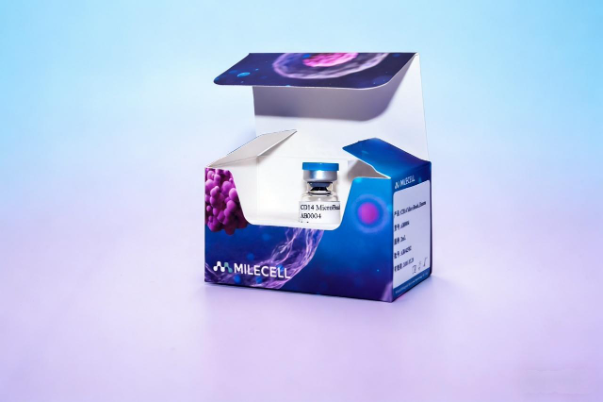
MileCell MagSep™ CD14 MicroBeads, Human are superparamagnetic nanoparticles conjugated to monoclonal anti-human CD14 antibodies for in vitro positive selection or depletion of CD14+ monocytes from mononuclear cells derived from peripheral blood, Leukopak, cord blood, bone marrow, and other single-cell suspensions.
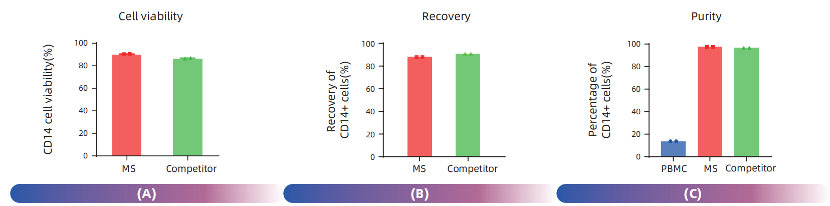
Figure 1. Fresh human peripheral blood mononuclear cells (PBMCs) derived from single donors served as the starting material to compare CD14+ monocyte isolation performance between MileCell MagSep™ CD14 MicroBeads and competitor products under identical conditions, assessing post-separation viability, recovery, and purity.
(A) Cell viability of Target Cells Post-Separation
(B) Recovery of Target Cells
(C) Purity of Target Cell Pre- and Post-Separation
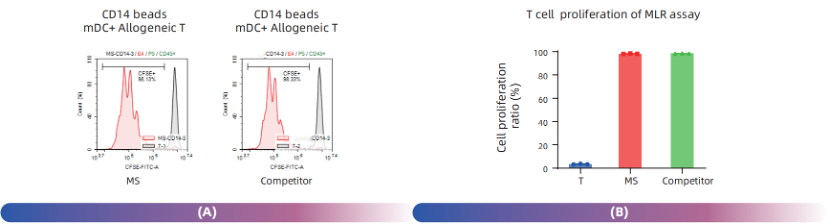
Figure 2. mDCs differentiated from isolated CD14+ monocyte were co-cultured with T cells from different donors for 5 days, and T cell proliferation was detected. Results show that the level of allogeneic T cell proliferation promoted by mDCs from the MileCell MagSep™ group was comparable to that of competitor products.
Cat. No. | Product Description | Size | Capacity |
AB0004 | CD14 MicroBeads, Human | 2mL | 1×10⁹ PBMCs |
Contact:
For inquiries regarding our products, services, or technical assistance, please contact: Info@milecell-bio.com

