

2025.12.21
The liver disease research landscape is evolving rapidly, and 3D spheroid models help translate molecular understanding into reliable drug screening platforms.
Primary Hepatocytes and Hepatic Stellate Cells (HSCs) grown together in 3D spheroids have been established as a powerful tool for studying liver fibrosis. By mimicking the natural cell–cell interactions of the liver microenvironment, these multicellular spheroids faithfully replicate key pathological features of fibrotic progression.
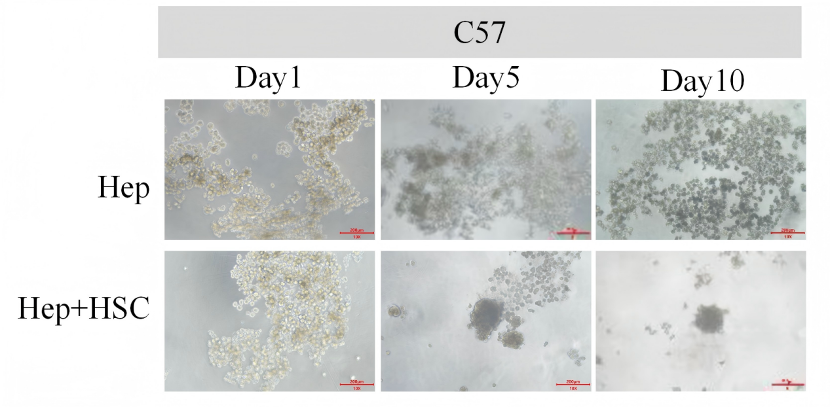
Figure 1. Milecell has tested hepatocytes from multiple species in two 3D spheroid models: Hepatocytes alone and Hepatocyte-HSC co-culture. The results show that HSCs can promote the spheroid formation of Hepatocytes and shorten the overall time required for spheroid formation. For more detailed data, please feel free to contact Info@milecell-bio.com.
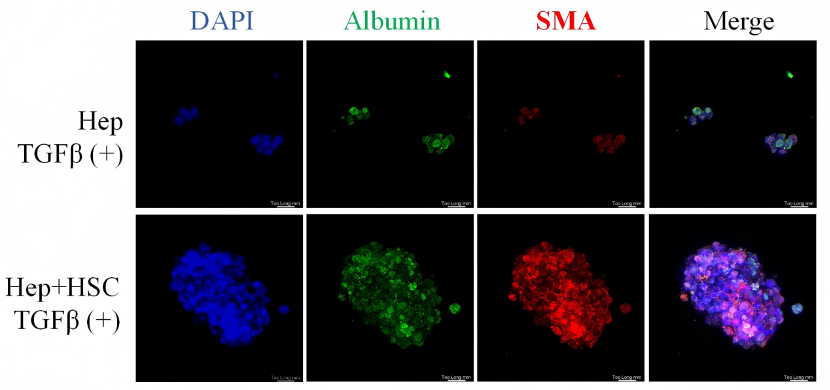
Figure 2. Confocal microscopy images of Hepatocyte-HSC co-culture spheroids and Hepatocytes monoculture spheroids. The pro-fibrotic effects of TGFβ were significantly amplified in 3D spheroids containing both hepatocytes and HSCs, as opposed to those containing hepatocytes alone. This enhanced fibrotic phenotype is primarily attributed to the activation of HSCs within the co-culture system.
Key Advantages of the 3D Co‑Culture Spheroid System:
Ø Physiologically Relevant Microenvironment: The 3D architecture and direct cell-cell interactions between hepatocytes and HSCs closely mimic the native liver tissue, leading to more authentic gene expression, metabolic functions, and disease progression compared to 2D monocultures.
Ø Superior Modeling of Liver Fibrosis: This system uniquely captures the critical interplay between hepatocyte injury and HSC activation—the central driver of fibrosis. It allows for the spontaneous or induced development of key fibrotic hallmarks, such as increased α-SMA expression and extracellular matrix deposition.
Ø Enhanced Predictive Power for Drug Discovery: The model's human-relevant pathology provides a robust platform for screening anti-fibrotic drug candidates. It enables the simultaneous assessment of compound effects on hepatocyte health, HSC activation, and fibrosis regression, improving the translation of results to clinical outcomes.
Ø Long-term Functional Stability: The 3D spheroid structure promotes enhanced hepatocyte polarity and longevity, supporting sustained metabolic activity and allowing for the study of chronic fibrotic processes over extended culture periods, which is challenging in traditional 2D systems.
Ø A Versatile Platform for Mechanism Studies: It serves as an excellent tool for dissecting molecular pathways in fibrosis. Researchers can easily manipulate specific cells (e.g., via gene editing in HSCs) within the co-culture to study paracrine signaling, validate therapeutic targets, and investigate mechanisms of fibrogenesis or resolution.
Milecell offers pre-qualified Hepatocyte and Non-Parenchymal Cells(Mixed NPCs,HSC,Kupffer Cells, LSECs) products for 3D spheroid models, streamlining your experimental workflow and accelerating research.

